
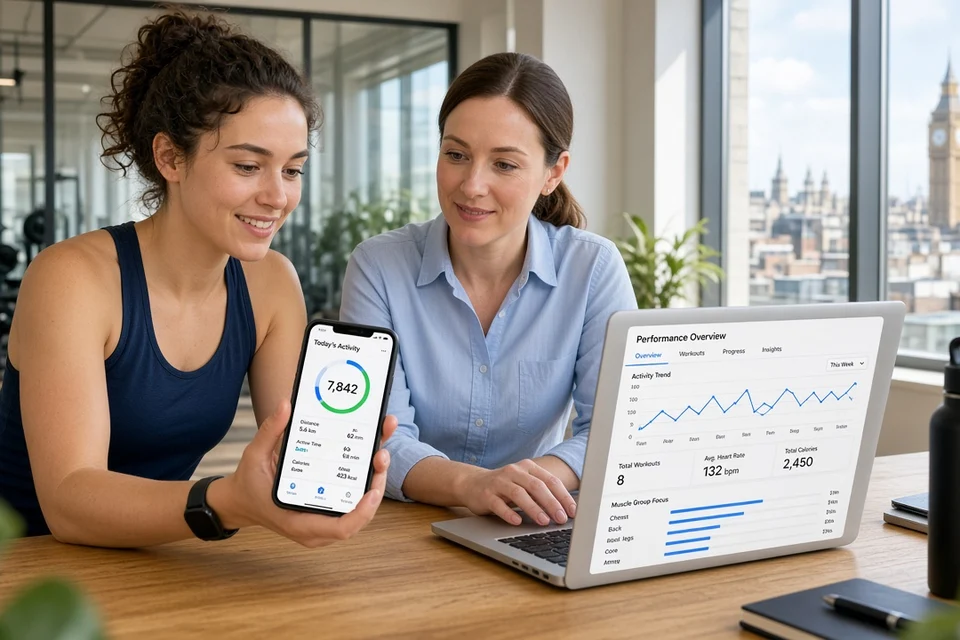
Fitness is no longer limited to gym memberships and personal training sessions. People across the UK are increasingly using digital platforms to track workouts, monitor activity, follow nutrition plans, book fitness classes, connect with trainers, and build healthier daily routines.
This shift is creating new opportunities for businesses to launch fitness and wellness app development in the UK, with solutions that combine exercise, nutrition, wellness, and personalized digital experiences in one platform.
A modern fitness app can do much more than count steps. For example, a user could open an app in the morning, receive a workout based on their fitness goal, track the session through a smartwatch, record their meals, and receive progress insights all from one platform.
For businesses, this creates opportunities to build fitness platforms for gyms, personal trainers, wellness brands, healthcare providers, fitness communities, and individual consumers. However, the success of an app depends on choosing the right features, technology, monetization strategy, and development approach from the beginning. If you are comparing wider mobile budgets, see our guide to mobile app development cost in the UK.
Key Takeaways
- The UK fitness and wellness market offers strong opportunities for digital fitness platforms, supported by growing app adoption and fitness participation.
- Successful apps should focus on a clear user need, such as workout planning, coaching, nutrition, activity tracking, or holistic wellness.
- Essential features include personalized plans, progress tracking, wearable integration, notifications, payments, and secure user accounts.
- Fitness and wellness app development costs in the UK can range from around £8,000 for an MVP to £100,000+ for advanced platforms.
- AI, wearable connectivity, personalization, and secure health-data management can create additional value but also increase development complexity.
Fitness & Wellness App Development Market Statistics in 2026
The global fitness apps market size is valued at approximately $13.9 billion to $22.3 billion in 2026, with an expected compound annual growth rate (CAGR) ranging from 11% to 13.4% over the coming decade.
Revenue in the fitness apps market is projected to reach US$9.12bn in 2026.
The global fitness app market size was valued at USD 12.27 billion in 2025. The market is projected to grow from USD 13.94 billion in 2026 to USD 38.71 billion by 2034, exhibiting a CAGR of 13.62% during the forecast period.
Why the UK Fitness and Wellness Market Is Ready for More Digital Solutions
The opportunity is not simply about building another workout-tracking app. UK users are increasingly looking for connected fitness experiences that combine exercise, nutrition, recovery, coaching, and community in one place.
Fitness Is Becoming More Personalized
Users increasingly expect apps to adapt to their individual goals rather than provide the same workout to everyone. A beginner trying to lose weight, for example, could receive a different workout schedule and nutrition guidance from an experienced runner training for a marathon.
Hybrid Fitness Experiences Are Growing
A fitness app can connect physical and digital experiences. A gym could allow members to book classes, access workout plans, track progress, and communicate with trainers through one application.
This aligns with the broader UK industry trend toward human support combined with well-integrated technology, rather than technology replacing the fitness experience altogether.
Wellness Is Extending Beyond Exercise
Modern wellness platforms can include meditation, sleep tracking, nutrition, stress management, recovery programs, and activity monitoring. For example, a user completing a workout could also receive recovery recommendations based on their activity and sleep data.
Opportunity for Fitness and Healthcare Businesses
Gyms, personal trainers, wellness brands, and healthcare-focused businesses can use apps to maintain stronger relationships with users beyond physical locations. A business working with healthcare app development in the UK can also explore connected wellness features where appropriate, particularly when fitness services overlap with broader health-management experiences.
What Can You Build? Popular Fitness & Wellness App Models
Before starting development, businesses should decide what problem the app will solve and who will use it. A gym membership app, a personal training platform, and a holistic wellness app may all fall under fitness and wellness, but their features and revenue models can be very different.
The UK market is also moving toward broader wellness experiences. Current industry trends show growing interest in recovery, personalised training, health tracking, and technology that connects different aspects of wellbeing.
On-Demand Workout Apps
These apps provide users with workout videos, exercise libraries, training programs, and personalised routines.
Example: A beginner could select “weight loss” and “30 minutes a day”, and the app could generate a weekly workout plan based on those preferences.
Personal Trainer & Coaching Apps
These platforms connect users with trainers and allow coaches to manage workouts, progress, schedules, and communication digitally.
For example, a personal trainer could assign a workout plan through the app, review completed exercises, and adjust the next week's programme without requiring the client to visit the gym.
Gym & Fitness Club Apps
Gyms can use apps for membership management, class bookings, workout tracking, trainer communication, payments, and notifications.
This model is particularly useful for creating a hybrid fitness experience, where the physical gym and digital platform work together rather than operating separately.
Nutrition & Diet Apps
Nutrition-focused platforms can provide meal plans, calorie tracking, food databases, hydration reminders, and progress monitoring. They can also connect nutrition data with workout goals to create a more complete fitness experience.
Holistic Wellness Apps
A broader wellness app can combine workouts with meditation, sleep, stress management, recovery, mindfulness, and lifestyle tracking. This approach reflects the growing consumer interest in wellness beyond traditional exercise.
AI-Powered Fitness Apps
AI can make fitness applications more personalised by analysing user activity, goals, workout history, and available data to recommend suitable routines.
For example, if a user consistently skips high-intensity workouts but completes shorter sessions, an AI-powered system could adapt plans toward shorter, more achievable workouts rather than repeatedly recommending the same routine. Our guide to AI development in the UK covers how these layers typically affect scope.
Wearable-Connected Fitness Apps
Apps can connect with smartwatches and other wearable devices to collect information such as activity, heart rate, sleep, and workout performance. This allows users to view their fitness information in one place and receive more personalised insights.
Essential Fitness & Wellness App Features for Better User Engagement
A successful fitness app does not need every possible feature at launch. The better approach is to build around the core user journey: set a goal → complete an activity → track progress → receive useful guidance → return consistently. Current fitness app development guidance also emphasizes workout tracking, personalization, progress dashboards, notifications, and health platform integration as core capabilities.
| Feature | What It Does | Simple Example |
|---|---|---|
| User Registration & Goal Setting | Collects fitness goals, preferences, and activity levels | The user selects weight loss, strength, or endurance |
| Personalized Workout Plans | Creates routines based on user goals and fitness level | A beginner receives a 3-day workout plan |
| Workout & Activity Tracking | Records exercises, duration, calories, distance, and performance | Runner tracks a 5 km outdoor session |
| Progress Dashboard | Displays progress through charts and statistics | The user compares this month's workouts with last month's |
| Wearable Integration | Connects with Apple Health, HealthKit, Health Connect, and compatible devices | Steps and heart-rate data sync automatically |
| Push Notifications | Sends reminders and motivational updates | The user receives a reminder before their scheduled workout |
| Nutrition Tracking | Records meals, calories, nutrients, and hydration | User logs breakfast and monitors daily calorie intake |
| AI-Based Recommendations | Personalizes workouts and insights using user data | The app suggests a lighter session after several intense workouts |
| Coach & Trainer Features | Allows trainers to create plans and monitor clients | A trainer reviews a client's weekly performance remotely |
| Subscription & Payments | Supports memberships, premium plans, and paid programs | Users subscribe to advanced coaching content |
Personalized Fitness Plans
Personalization can make the experience more relevant than a simple exercise library. The app can consider a user's goal, fitness level, available equipment, schedule, and previous performance before recommending a routine.
Wearable and Health Data Integration
Wearable connectivity allows users to avoid manually entering every activity. Data such as steps, workouts, heart rate, and sleep can be synchronized through supported health platforms, creating a more connected experience.
Progress Tracking and Smart Insights
Users need to see whether their effort is producing results. Visual dashboards can show completed workouts, personal records, activity trends, weight changes, or other relevant metrics. AI can then turn this data into practical recommendations instead of simply displaying numbers.
Engagement and Community Features
Challenges, streaks, achievement badges, leaderboards, and community groups can give users additional reasons to return. However, these should support the core fitness journey rather than distract from it.
Admin and Trainer Dashboard
The business side of the application also needs attention. An admin panel can manage users, subscriptions, workout content, trainers, notifications, analytics, and reported issues, while trainers can manage individual client programs and progress.
The key is prioritization: launch with features that support the app's main purpose, then introduce advanced AI, social, wearable, or coaching capabilities as the user base grows. This can help control both development complexity and the overall budget.
How to Develop a Fitness & Wellness App in the UK: A Step-by-Step Guide
A successful fitness app starts with a specific user problem, not a long list of features. For example, an app designed for gym members may focus on workout tracking and class bookings, while a wellness platform may prioritize meditation, nutrition, sleep, and personalized recommendations.
A structured development process helps control the scope, cost, and user experience. Wearable and health-platform integrations should also be considered early because they can affect the app architecture and testing requirements. For the wider mobile process, see mobile app development in the UK.
1. Research the Market and Target Users
Study UK fitness trends, competitors, user reviews, and gaps in existing apps. Define whether your primary audience is gym members, athletes, beginners, personal-training clients, or wellness-focused users.
2. Define the App Concept and MVP
Decide what the first version must accomplish. For example, an MVP for a personal training app could include profiles, workout plans, progress tracking, trainer communication, and subscriptions without adding every advanced feature at launch.
3. Plan the Features and User Journey
Map how users will move through the application, from registration and goal setting to completing workouts and reviewing progress. This helps eliminate unnecessary features and creates a smoother experience.
4. Design the UI/UX
Create wireframes and interactive designs for onboarding, workout screens, dashboards, nutrition tracking, and other core functions. Fitness apps should make important actions quick and easy, especially when users are exercising. Businesses investing in mobile app UI/UX design in the UK should keep workouts readable and low-friction.
5. Choose the Technology Stack
Select the appropriate frontend, backend, database, APIs, cloud infrastructure, and development approach. Cross-platform development can be useful for reaching both iOS and Android users efficiently, while native development may be preferable for deeper platform-specific or wearable functionality.
6. Develop the App and Integrations
Develop the mobile application, backend, admin panel, payment system, notifications, and required integrations. If the app uses wearable or health data, integrations such as Apple HealthKit and Android Health Connect should be planned carefully because their data models and permission systems differ.
7. Test Security, Performance, and Real-World Usage
Test the app across supported devices, operating systems, network conditions, and wearable integrations. Security testing is particularly important because fitness applications can handle sensitive health and activity information. Structured mobile app testing in the UK should cover functional, performance, API, and security checks.
8. Launch, Measure, and Improve
After App Store and Google Play submission, monitor crashes, user engagement, workout completion, subscriptions, and feedback. Use this information to improve the product and introduce features users actually want rather than adding features based only on assumptions.
A practical development approach is to launch a focused MVP, validate it with real users, and then expand the platform with AI personalization, community features, advanced analytics, and additional wearable integrations. This can help control both development risk and the initial budget.
Technology Stack for Fitness & Wellness App Development
The technology stack should match the app's features rather than simply following the latest trend. A basic workout-tracking app can use a lightweight stack, while an application with wearable connectivity, AI recommendations, live classes, and real-time tracking requires more advanced infrastructure.
| Technology Layer | Recommended Technologies | Estimated Cost Impact |
|---|---|---|
| Mobile App | Flutter, React Native | £10,000–£30,000 |
| Native Development | Swift, Kotlin | £20,000–£50,000+ |
| Backend | Node.js, Python, FastAPI | £8,000–£25,000 |
| Database | PostgreSQL, MongoDB, Firebase | £4,000–£12,000 |
| Cloud Infrastructure | AWS, Google Cloud, Azure, Firebase | £3,000–£12,000 |
| Health & Wearable APIs | Apple HealthKit, Health Connect, wearable SDKs | £5,000–£15,000+ |
| AI & Machine Learning | OpenAI APIs, TensorFlow, Core ML | £5,000–£30,000+ |
| Payments | Stripe, Apple Pay, Google Pay | £2,000–£7,000 |
| Analytics | Firebase Analytics, Mixpanel, PostHog | £1,500–£5,000 |
| Security & Authentication | OAuth, JWT, MFA, biometric authentication | £3,000–£10,000 |
For businesses planning a more complex product, choosing an experienced fitness app development company in the UK can help balance technology requirements with development budget and long-term scalability.
How Much Does Fitness & Wellness App Development Cost in the UK?
The fitness and wellness app development cost in the UK depends mainly on the app's complexity, number of platforms, integrations, AI capabilities, design requirements, and security needs. Current UK development estimates place fitness and wellness apps broadly between £8,000 and £100,000+, while more advanced platforms with AI, wearables, live coaching, or complex integrations can go beyond this range.
| App Type | Estimated Cost | Development Timeline |
|---|---|---|
| Basic Fitness MVP | £8,000–£25,000 | 2–3 months |
| Standard Fitness & Wellness App | £25,000–£50,000 | 4–5 months |
| Advanced Wellness Platform | £50,000–£75,000+ | 6–9 months |
| Enterprise-Level Platform | £75,000–£100,000+ | 9–12+ months |
What Does the Cost to Build a Fitness App Actually Include?
The development budget can cover:
- UI/UX research and design
- iOS and Android development
- Backend and database development
- Admin and trainer dashboards
- API and wearable integrations
- Payment and subscription systems
- Quality assurance and testing
- App-store launch support
Businesses researching broader mobile app development cost in the UK should therefore compare quotes based on the actual scope and deliverables rather than choosing a provider solely because it offers the lowest initial price. Current UK app pricing guides show substantial variation based on complexity and integrations.
Key Factors to Consider When Estimating Fitness App Development Cost
The cost of developing a fitness and wellness app is shaped by more than the number of features. Platform choices, integrations, design complexity, AI functionality, and ongoing infrastructure can all change the final budget.
| Factor | Impact on Development Cost |
|---|---|
| App Complexity | More advanced workflows, dashboards, and user roles require additional development time. |
| Number of Platforms | Building separately for iOS and Android can cost more than using a cross-platform framework. |
| UI/UX Design | Custom interfaces, animations, interactive workout screens, and personalised experiences increase design effort. |
| Wearable Integration | Connecting Apple Watch, HealthKit, Health Connect, or other wearables requires additional APIs and testing. |
| AI Features | AI coaching, personalised workout recommendations, predictive insights, and AI assistants can significantly increase costs. |
| Third-Party Integrations | Payments, video calls, maps, nutrition databases, CRM systems, and other APIs add integration work. |
| Backend Infrastructure | Large user volumes, real-time data, video content, and complex analytics require stronger infrastructure. |
| Security & Compliance | Authentication, encryption, privacy controls, monitoring, and security testing add development effort. |
| Development Team Location | Developer rates vary significantly between the UK and overseas development teams. |
| Maintenance & Updates | Bug fixes, OS updates, security improvements, new features, and cloud costs create ongoing expenses. |
AI and Personalization
Adding AI can transform a basic workout application into a more intelligent fitness platform. However, AI model integration, data processing, recommendation systems, testing, and ongoing model/API costs can increase the budget considerably.
Wearable and Health Integrations
A simple fitness tracker may only require basic activity data, while advanced applications can synchronize workouts, heart rate, sleep, and other metrics. Each additional integration can increase development and testing requirements.
Custom Design and User Experience
A standard interface is generally less expensive than a completely custom experience with animated exercise demonstrations, interactive progress charts, personalized dashboards, and trainer-specific workflows.
Backend and Scalability
An application serving a few hundred users has different infrastructure requirements from a platform designed for thousands or millions of users. Real-time tracking, video streaming, analytics, and large volumes of health data can increase both development and infrastructure costs.
Development Team and Hiring Model
The choice between an in-house team, freelancers, or a specialized development partner can significantly affect the budget. Businesses comparing development options can use resources such as how to hire mobile app developers in the UK to evaluate technical expertise, portfolio quality, communication, pricing, and post-launch support.
How Fitness & Wellness Apps Make Money Through Different Revenue Models
A fitness app can generate revenue in several ways, but the best model depends on whether the platform focuses on workouts, coaching, nutrition, memberships, or a broader wellness experience. For apps that provide continuous value through training plans and personalised content, subscriptions are particularly suitable.
Subscription Plans
Users can pay monthly or annually for premium workouts, personalised plans, advanced analytics, AI coaching, nutrition programs, or exclusive content.
Example: A fitness app could offer basic workout tracking for free while charging £9.99/month for personalised training plans and detailed progress insights.
Freemium Model
The app can provide essential features at no cost and place advanced capabilities behind a premium plan. This lets users experience the product before deciding whether to pay. Apple officially supports freemium models with premium features, content, and subscriptions.
In-App Purchases
Businesses can sell individual workout programs, meal plans, fitness challenges, training packages, or premium content as one-time purchases.
Trainer or Coach Commissions
A marketplace connecting users with personal trainers can charge a commission on bookings or coaching packages. For example, if a user books a £50 virtual training session, the platform could retain a percentage as its service fee.
Advertising and Brand Partnerships
Free fitness apps can generate revenue through relevant advertisements, sponsored challenges, fitness products, or partnerships with gyms and wellness brands. However, advertising should not interfere with workouts or create a poor user experience.
Conclusion
The UK fitness and wellness market presents a strong opportunity for businesses that can turn everyday health goals into simple, personalized digital experiences. With 12.2 million UK health and fitness club members and a fitness app market projected to reach US$1.29 billion by 2033, demand for technology-driven fitness solutions continues to grow.
However, building a successful app is not about adding the maximum number of features. A focused user experience, personalized workouts, reliable tracking, wearable integration, secure data handling, and a sustainable monetization strategy are more important.
Businesses should begin with a clear MVP, validate it with real users, and then expand with AI coaching, advanced analytics, community features, or additional health integrations as demand grows. With the right development strategy and technology partner, a fitness and wellness app can become more than a digital workout tool; it can become a long-term platform for user engagement, retention, and business growth.
Frequently Asked Questions
1. How much does it cost to develop a fitness app in the UK?
Fitness app development can cost approximately £8,000–£100,000+, depending on features, platforms, integrations, AI capabilities, and complexity.
2. How long does it take to build a fitness and wellness app?
A basic MVP can take around 2–3 months, while an advanced platform may require 6–12+ months.
3. What features should a fitness app have?
Important features include user profiles, goal setting, workout plans, activity tracking, progress dashboards, notifications, payments, wearable integration, and personalized recommendations.
4. Can a fitness app connect with smartwatches?
Yes. Apps can integrate with platforms such as Apple HealthKit and Android Health Connect, as well as compatible wearable-device APIs, depending on the required data and permissions.
5. Can AI be added to a fitness and wellness app?
Yes. AI can support personalized workout recommendations, fitness insights, conversational coaching, progress analysis, and adaptive training plans.
6. How can a fitness app generate revenue?
Common monetization options include subscriptions, freemium plans, in-app purchases, trainer commissions, advertising, sponsored programs, and premium coaching.
7. What should businesses consider when developing a fitness app in the UK?
Businesses should consider their target users, feature scope, development budget, data privacy, security, wearable integrations, accessibility, monetization model, and long-term scalability.