
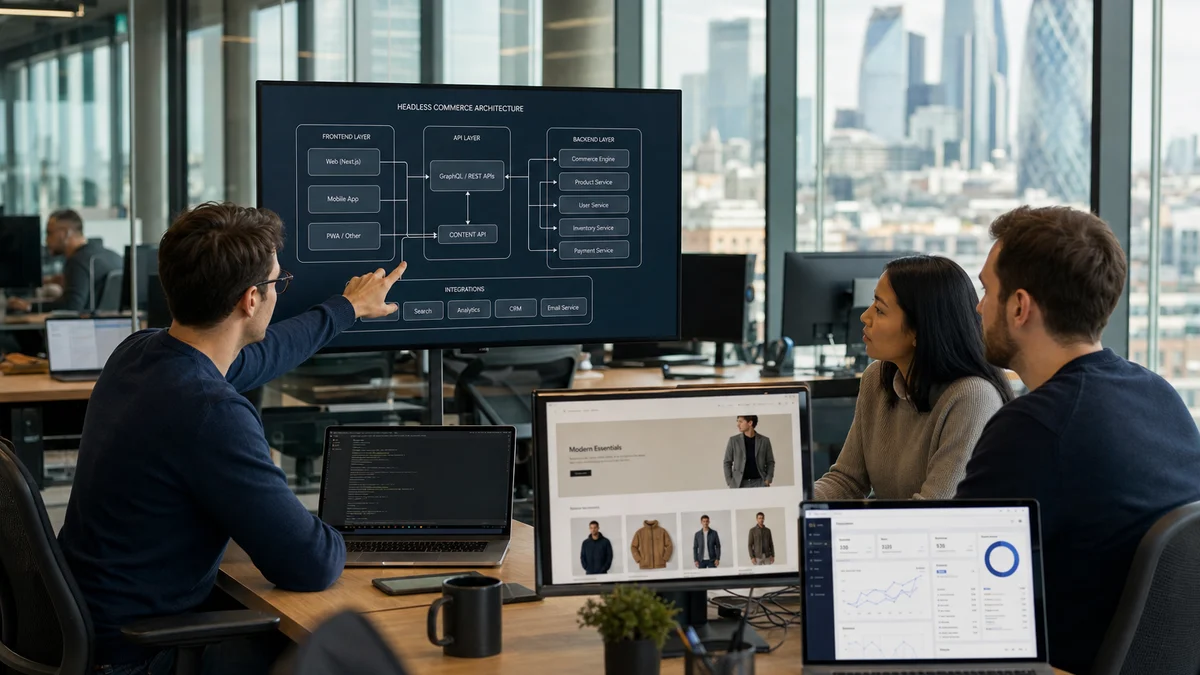
Headless eCommerce Development in London: Complete Guide
Traditional eCommerce platforms make launching an online store relatively easy, but growing businesses often reach a point where speed, flexibility, and customer experience become difficult to improve.
If you're planning a new online store or modernizing an existing one, understanding headless commerce is essential. In this guide, you'll learn how headless eCommerce development in London works, why more businesses are adopting it, and whether it's the right architecture for your growth strategy.
What Is Headless eCommerce Development?
Headless eCommerce development is an architecture that separates the frontend customer experience from the backend commerce engine, allowing both layers to evolve independently through APIs.
Unlike traditional eCommerce platforms where the storefront, checkout, product catalog, and business logic are tightly connected, headless commerce decouples the presentation layer from the commerce platform.
The frontend communicates with the backend using Application Programming Interfaces (APIs), giving businesses complete control over how customers interact with their brand across every digital touchpoint.
For example, a London fashion retailer can use Next.js to build an ultra-fast website while keeping Shopify, Adobe Commerce (Magento), BigCommerce, CommerceTools, Saleor, or Medusa as the backend commerce engine. Product information, inventory, pricing, customer accounts, and checkout continue to run from the backend, while the frontend delivers a highly customized shopping experience.
This architecture also supports headless CMS platforms such as Contentful, Sanity, Storyblok, and Strapi, allowing marketing teams to publish content without depending on developers for every website update.
How Does Headless Commerce Work?
A headless commerce ecosystem typically consists of:
- Frontend Framework: Next.js, React, Vue.js, Nuxt
- Commerce Platform: Shopify, Adobe Commerce, BigCommerce, CommerceTools, Saleor
- Headless CMS: Contentful, Sanity, Storyblok, Strapi
- Commerce APIs: Product, Cart, Checkout, Orders, Inventory
- Third-party Integrations: Payment gateways, ERP, CRM, PIM, search, analytics, marketing automation, and shipping providers
Instead of relying on one monolithic platform, every component communicates through APIs. This modular approach makes it easier to add new features, replace technologies, and support future business growth.
Headless eCommerce development involves connecting a frontend application, commerce platform, CMS, and third-party services using API-first architecture.
Modern retailers are increasingly investing in API-first commerce because it provides greater agility for omnichannel retail experiences. According to industry research, 73% of businesses now operate with headless website architecture, reflecting the growing adoption of API-driven digital commerce.
Why Is Headless Commerce Different?
Traditional eCommerce platforms are designed as all-in-one systems, where the frontend and backend depend on each other. While this simplifies setup, it often limits customization and makes major design or performance improvements more difficult as the business grows.
Headless commerce removes these limitations by allowing developers to build unique customer experiences without changing the underlying commerce engine.
For example:
- A retailer can redesign the website without affecting inventory management.
- A mobile shopping app can use the same backend as the website.
- Digital kiosks, marketplaces, voice commerce, and social commerce can all connect to one commerce platform.
This flexibility is one of the biggest reasons why custom eCommerce development services increasingly recommend headless architecture for businesses planning long-term growth.
Why Businesses in London Are Exploring Headless Commerce
London has become one of Europe's leading technology and retail innovation hubs. Businesses are competing not only on product quality but also on website speed, user experience, personalization, and omnichannel commerce.
As customer expectations continue to rise, many organizations are moving beyond traditional eCommerce platforms to create faster and more flexible digital experiences. Headless architecture supports these goals by enabling:
- Faster website performance
- Better Core Web Vitals
- Personalized shopping journeys
- Mobile-first experiences
- Multi-store management
- International expansion
- Easier integration with ERP, CRM, and marketing platforms
Performance also plays a measurable role in online retail. The HTTP Archive's 2025 Web Almanac highlights that Core Web Vitals directly influence real-world experience across ecommerce sites, with loading performance and responsiveness remaining critical factors for successful online shopping experiences.
Why Does Headless eCommerce Matter for Modern Businesses?
Headless eCommerce matters because it gives businesses the flexibility to deliver faster, more personalized, and scalable shopping experiences without being restricted by the limitations of a traditional eCommerce platform.
Moreover, today's online shoppers expect websites to load quickly, work seamlessly across every device, and provide consistent experiences whether they shop through a website, mobile app, marketplace, social commerce channel, or in-store kiosk. A monolithic platform can struggle to keep pace with these expectations as your business grows, while API-first commerce architecture makes it easier to innovate without rebuilding your entire commerce system.
Businesses typically choose headless commerce when they need faster website performance, omnichannel capabilities, advanced customization, or enterprise scalability.
For businesses investing in eCommerce website development in London, headless architecture is increasingly becoming a strategic advantage rather than just a technology upgrade.
Faster Performance Improves Customer Experience
Website performance directly affects user engagement, conversions, and customer satisfaction.
First, headless storefronts built with Next.js, React, Astro, or Vue.js generate optimized pages, reduce unnecessary code, and improve rendering performance. This creates faster browsing experiences, particularly on mobile devices where most online shopping now happens.
For example, a luxury retailer using Shopify Hydrogen + Next.js can preload product pages, optimize images, and reduce JavaScript execution compared to a heavily customized traditional storefront.
Performance also impacts measurable user experience. The HTTP Archive Web Almanac 2025 found that Largest Contentful Paint (LCP) remains the biggest differentiator between eCommerce platforms, reinforcing why frontend optimization is a major priority for modern online stores.
Key takeaway: Headless architecture doesn't automatically make a website fast — but it gives developers significantly more control to optimize performance.
Better SEO and Core Web Vitals
Headless commerce helps improve technical SEO by giving developers greater control over website performance, rendering, and structured data implementation.
Unlike template-driven storefronts, developers can optimize:
- Server-side rendering (SSR)
- Static Site Generation (SSG)
- Incremental Static Regeneration (ISR)
- Image optimization
- Schema markup
- Metadata
- URL structures
- Canonical tags
For example, a London electronics retailer migrating from a legacy Magento store to Next.js + Adobe Commerce can improve page speed while maintaining enterprise catalog functionality.
Google also continues to emphasize Core Web Vitals as part of overall page experience. The 2025 HTTP Archive shows significant differences in CWV performance across major commerce platforms, highlighting the importance of frontend optimization and architectural decisions.
Omnichannel Commerce Without Duplicate Systems
Omnichannel commerce allows businesses to deliver one consistent shopping experience across multiple customer touchpoints using a shared backend.
Instead of managing separate systems, a single commerce engine can power:
- eCommerce websites
- Mobile apps
- Progressive Web Apps (PWAs)
- Digital kiosks
- Smart devices
- Voice commerce
- Social commerce
- Marketplace integrations
For example, a London fashion brand can display identical inventory, promotions, pricing, loyalty points, and customer accounts across its website, iOS app, Android app, and in-store tablet.
This is where composable commerce and API-first development provide long-term business value.
Easier Scalability and Future-Proof Architecture
Headless architecture allows businesses to upgrade individual components without rebuilding the entire eCommerce platform.
As your company grows, you may want to:
- Replace your CMS
- Add AI-powered product recommendations
- Integrate a Product Information Management (PIM) system
- Connect an ERP
- Add multilingual storefronts
- Launch international websites
- Implement personalization engines
With traditional platforms, these upgrades often require major redevelopment. With headless architecture, APIs make replacing or expanding individual services much simpler.
Unlike traditional eCommerce platforms, headless commerce gives businesses complete control over the customer experience while retaining a centralized commerce backend.
What Is the Difference Between Traditional and Headless eCommerce?
Traditional eCommerce combines the frontend and backend into one tightly connected platform, while headless eCommerce separates both layers so they communicate through APIs.
Although traditional platforms remain an excellent choice for many businesses, growing retailers often encounter limitations around customization, scalability, and omnichannel expansion. Headless commerce addresses these challenges by allowing each layer of the technology stack to evolve independently.
Traditional vs Headless eCommerce Comparison
| Feature | Traditional eCommerce | Headless eCommerce |
|---|---|---|
| Architecture | Monolithic | API-first, decoupled |
| Frontend Flexibility | Limited by platform | Fully customizable |
| Website Performance | Theme-dependent | Optimized with Next.js, React, Vue |
| Core Web Vitals | Harder to optimize | Greater optimization control |
| Omnichannel Support | Limited | Native multi-channel support |
| CMS Options | Built-in CMS | Contentful, Sanity, Storyblok, Strapi |
| Technology Stack | Platform-defined | Best-of-breed architecture |
| Scalability | Moderate | Enterprise-grade |
| Development Cost | Lower upfront | Higher initial investment |
| Long-term Flexibility | Moderate | Very high |
When Is Traditional eCommerce the Better Choice?
Traditional platforms remain a practical solution for:
- Small businesses
- Local retailers
- Startups validating a business idea
- Stores with limited customization needs
- Companies seeking faster launch times
For example, a startup selling fewer than 300 products may achieve excellent results with a well-optimized Shopify or WooCommerce store before investing in headless architecture.
Businesses that are still comparing platform flexibility should also understand how custom eCommerce compares with Shopify before committing to a long-term architecture.
When Should a Business Choose Headless Commerce?
Headless commerce becomes a stronger choice when your business needs:
- Multiple storefronts
- International expansion
- Advanced personalization
- High-traffic websites
- Complex B2B commerce
- Enterprise integrations
- Custom checkout experiences
- Marketplace functionality
- Mobile-first commerce
- Digital experience platforms (DXPs)
For example, many London retailers expanding across Europe adopt Next.js + Shopify Plus, Adobe Commerce, or BigCommerce to support multilingual storefronts, localized pricing, ERP integration, and high-performance user experiences without replacing their backend commerce operations.
How Does Headless eCommerce Architecture Work?
Headless eCommerce architecture connects an independent frontend, commerce engine, CMS, and third-party business systems through APIs so every component can evolve without affecting the others.
Unlike a monolithic platform where every feature is tightly coupled, API-first commerce lets businesses choose the best technology for each layer. This approach aligns with modern MACH (Microservices, API-first, Cloud-native, Headless) principles and supports composable commerce strategies adopted by many enterprise retailers.
Core Components of a Headless Commerce Stack
A production-ready headless solution typically includes the following layers:
| Layer | Popular Technologies | Business Purpose |
|---|---|---|
| Frontend | Next.js, React, Vue.js, Nuxt | Fast customer experience |
| Commerce Engine | Shopify Plus, Adobe Commerce, BigCommerce, CommerceTools, Saleor, Medusa | Products, pricing, checkout, inventory |
| Headless CMS | Contentful, Storyblok, Sanity, Strapi | Marketing content management |
| APIs | REST APIs, GraphQL, Storefront APIs | Data communication |
| Search | Algolia, Elasticsearch | Product discovery |
| Payments | Stripe, PayPal, Adyen | Secure checkout |
| CDN & Hosting | Vercel, Netlify, Cloudflare, AWS | Global performance |
What Are the Biggest Benefits of Headless eCommerce Development?
Headless eCommerce improves business agility, website performance, scalability, personalization, and omnichannel commerce while giving developers complete frontend flexibility.
Superior Website Speed
Modern frameworks such as Next.js, React, and Hydrogen optimize rendering, image delivery, and caching.
For example, retailers commonly achieve 20–50% faster page load times after moving to headless storefronts. Faster websites improve engagement, SEO, and conversion opportunities.
Better Customer Experience
Headless allows businesses to design experiences around customer behavior rather than platform limitations.
Examples include:
- AI-powered product recommendations
- Personalized homepages
- Dynamic promotions
- Region-specific pricing
- One-page checkout
- Progressive Web Apps (PWAs)
Easier Integrations
Businesses can integrate:
- ERP systems
- CRM platforms
- PIM software
- Marketing automation
- AI search
- Loyalty programs
- Subscription billing
- Analytics platforms
without rebuilding the storefront.
Future Scalability
Launching additional storefronts, marketplaces, or mobile applications becomes much simpler because every channel shares the same commerce backend.
Headless commerce enables businesses to scale across multiple customer channels without duplicating backend commerce operations.
What Challenges Should Businesses Expect During Headless Commerce Implementation?
Headless commerce offers greater flexibility, but it also requires higher technical expertise, careful planning, and a larger initial investment than traditional platforms.
Businesses should evaluate these challenges before committing, as many implementation issues stem from the same common eCommerce development mistakes that affect traditional and headless projects alike.
Higher Development Costs
Unlike theme-based development, headless projects require:
- Frontend engineering
- API integrations
- CMS configuration
- DevOps
- Infrastructure setup
- Performance optimization
Industry experience shows headless implementations often cost significantly more upfront than traditional storefronts because two independent systems are being developed and maintained.
Ongoing Maintenance
Businesses must maintain:
- Frontend application
- Backend commerce platform
- APIs
- CDN
- Security updates
- Monitoring
- CI/CD pipelines
This makes long-term technical support essential.
Which Technologies Are Commonly Used in Headless eCommerce Projects?
Technology selection should align with your business size, technical requirements, and future growth plans.
Recommended stack:
- Frontend: Next.js, React, Vue.js, Nuxt
- Commerce Platforms: Shopify Plus, Adobe Commerce, BigCommerce, CommerceTools, Saleor, Medusa
- CMS: Contentful, Storyblok, Sanity, Strapi
- Hosting: Vercel, AWS, Cloudflare
- Payments: Stripe, Adyen, PayPal
- Search: Algolia, Elasticsearch
- Analytics: Google Analytics 4, Google Tag Manager
What Is the Headless eCommerce Development Process?
A successful headless eCommerce development process follows a structured implementation roadmap that aligns business goals, technology decisions, and customer experience while minimizing migration risks and supporting long-term scalability.
Unlike traditional eCommerce projects that primarily focus on theme customization, headless implementations require planning across business strategy, solution architecture, API integrations, frontend engineering, content management, infrastructure, and ongoing optimization.
Skipping any phase often leads to integration issues, poor performance, or higher maintenance costs after launch. Shopify also recommends defining business goals and understanding architectural requirements before selecting a headless approach.
1. Business Discovery and Technical Audit
Business discovery identifies your commercial objectives, while a technical audit evaluates your existing eCommerce ecosystem to create the right migration strategy.
This is the most important stage because technology should solve business problems — not create new ones. Before writing a single line of code, experienced development teams analyze your current website, customer journey, operational workflows, and long-term growth plans.
During this phase, the team typically evaluates:
- Business goals and KPIs
- Current eCommerce platform (Shopify, Magento, WooCommerce, BigCommerce)
- Product catalog complexity
- Website traffic and scalability requirements
- Core Web Vitals and SEO performance
- Existing integrations (ERP, CRM, PIM, WMS)
- Customer pain points
- International expansion plans
For example, a London fashion retailer with slow mobile performance and multiple regional stores may require a different architecture than a B2B manufacturer managing thousands of wholesale SKUs. The discovery phase helps identify these differences before development begins.
Expert Tip: Don't start with "Which framework should we use?" Start with "What business problem are we trying to solve?"
2. Platform Selection
Platform selection determines the commerce engine that will manage products, orders, inventory, customers, and checkout for your headless storefront.
Not every business requires the same commerce platform. The right choice depends on your business model, customization requirements, budget, and future growth plans.
Popular options include:
- Shopify Plus — Ideal for fast-growing D2C brands and global retailers.
- Adobe Commerce (Magento) — Suitable for enterprises with highly customized workflows.
- BigCommerce — Strong choice for API-first and B2B commerce.
- CommerceTools — Enterprise composable commerce platform.
- Saleor — Open-source solution for custom commerce applications.
- Medusa — Flexible Node.js-based commerce engine for developer-centric projects.
Rather than selecting the platform with the most features, choose the one that aligns with your operational needs, integration requirements, and total cost of ownership.
Shopify notes that businesses should evaluate architectural options based on business objectives rather than assuming headless is always the best choice.
3. Solution Architecture
Solution architecture defines how every component in the headless ecosystem communicates, scales, and performs together.
This phase creates the technical blueprint for the project. Architects determine how the frontend, commerce engine, CMS, APIs, authentication, search, payment gateways, analytics, and cloud infrastructure will interact.
A typical architecture includes:
- Frontend (Next.js or React)
- Commerce backend
- Headless CMS
- GraphQL or REST APIs
- Search engine (Algolia or Elasticsearch)
- CDN and hosting
- Authentication services
- Third-party integrations
A well-designed architecture ensures that future features such as multilingual storefronts, AI recommendations, subscription commerce, or marketplace functionality can be added without rebuilding the entire platform.
4. UI/UX Design
UI/UX design transforms business requirements into intuitive shopping experiences that improve engagement and conversions.
Unlike traditional theme customization, headless development gives designers complete creative freedom. Every customer interaction — from homepage navigation to checkout — is designed around user behavior instead of platform limitations.
The design process typically includes:
- Customer journey mapping
- Wireframes
- Interactive prototypes
- Mobile-first layouts
- Accessibility compliance (WCAG)
- Conversion-focused checkout design
- Component-based design systems
For example, an electronics retailer may prioritize advanced product filtering and comparison tools, while a luxury fashion brand may focus on immersive storytelling and visual merchandising.
5. Frontend Development
Frontend development builds the customer-facing storefront using modern JavaScript frameworks that deliver fast, responsive, and SEO-friendly experiences.
This is where the visual experience comes to life. Developers build reusable UI components, optimize page rendering, implement responsive layouts, and ensure compatibility across devices.
Common frontend technologies include:
- Next.js
- React
- Vue.js
- Nuxt
- Shopify Hydrogen
Developers also optimize:
- Core Web Vitals
- Lazy loading
- Image optimization
- Static Site Generation (SSG)
- Server-Side Rendering (SSR)
- Incremental Static Regeneration (ISR)
The result is a storefront that loads quickly, ranks better in search engines, and delivers a smoother shopping experience.
6. Commerce API Integration
Commerce API integration connects the frontend to the backend so customers can browse products, manage carts, place orders, and complete secure checkouts.
APIs are the foundation of headless commerce. They synchronize real-time business data between independent systems without tightly coupling them.
Common API integrations include:
- Product catalog
- Inventory
- Pricing
- Shopping cart
- Customer accounts
- Checkout
- Orders
- Promotions
- Loyalty programs
Reliable API design is critical because every customer interaction depends on these connections. Poor API performance can directly affect website speed and user experience.
7. CMS Implementation
CMS implementation enables marketing teams to manage website content independently without requiring frontend code changes.
A headless CMS separates content management from presentation, allowing businesses to publish content across websites, mobile apps, kiosks, and other digital channels from a single source.
Popular headless CMS platforms include:
- Contentful
- Storyblok
- Sanity
- Strapi
Content models are carefully designed to support product pages, landing pages, blogs, promotions, and localization. Proper content modeling reduces future development effort and improves long-term scalability.
8. ERP, CRM, and Payment Integration
Enterprise integrations synchronize operational systems to create one connected digital commerce ecosystem.
Rather than operating in silos, headless commerce integrates with essential business platforms, including:
- ERP (SAP, Microsoft Dynamics, NetSuite)
- CRM (Salesforce, HubSpot)
- PIM
- WMS
- Marketing automation
- Payment gateways (Stripe, Adyen, PayPal)
- Shipping providers
These integrations automate inventory updates, customer data synchronization, order processing, and fulfillment workflows, reducing manual work and improving operational efficiency.
9. QA Testing
Quality assurance testing verifies that every feature works correctly before the website goes live.
Comprehensive testing includes:
- Functional testing
- API testing
- Cross-browser compatibility
- Mobile responsiveness
- Checkout validation
- Security testing
- Performance testing
- Accessibility testing
- User acceptance testing (UAT)
This phase identifies issues early, reducing the risk of post-launch failures and protecting the customer experience.
10. Performance Optimization
Performance optimization improves speed, scalability, and user experience by fine-tuning both frontend and infrastructure.
Optimization activities include:
- CDN configuration
- API caching
- Image compression
- Code splitting
- Bundle optimization
- Database optimization
- Edge rendering
- Monitoring Core Web Vitals
Continuous optimization helps maintain fast load times as traffic, product catalogs, and customer interactions grow.
11. Deployment
Deployment publishes the headless commerce solution to a production environment using automated DevOps and CI/CD practices.
Instead of manually releasing updates, modern teams use automated deployment pipelines that improve reliability and reduce downtime.
Deployment activities typically include:
- Infrastructure provisioning
- Environment configuration
- SSL setup
- DNS updates
- CDN activation
- Monitoring tools
- Rollback strategies
A controlled launch minimizes disruption and ensures business continuity during migration.
12. Continuous Maintenance and Optimization
Continuous maintenance keeps the headless commerce platform secure, high-performing, and aligned with changing business requirements.
Launching the website is only the beginning. Successful businesses continuously improve their digital commerce experience by monitoring performance, updating APIs, strengthening security, and introducing new features based on customer feedback.
Ongoing maintenance usually covers:
- Security patches
- API version upgrades
- Framework updates
- Performance monitoring
- Feature enhancements
- SEO improvements
- Analytics reviews
- Conversion rate optimization (CRO)
- Infrastructure scaling
Businesses that treat headless commerce as an ongoing digital product — not a one-time project — are better positioned to adapt to changing customer expectations and market demands. Continuous improvement is a core principle of modern headless commerce strategies.
Which Businesses Benefit Most from Headless Commerce?
Headless commerce delivers the highest ROI for businesses with complex customer journeys, multiple sales channels, or rapid growth plans.
Common use cases include:
- Fashion retailers
- Luxury brands
- Electronics stores
- B2B manufacturers
- Subscription businesses
- Marketplace platforms
- Multi-brand retailers
- International commerce
- Enterprise distributors
Large product catalogs, multilingual storefronts, and omnichannel experiences are where headless architecture creates the greatest competitive advantage.
How Much Does Headless eCommerce Development Cost in London?
The cost of headless eCommerce development in London depends on project complexity, technology stack, integrations, custom functionality, and long-term infrastructure requirements.
Typical investment ranges are:
| Project Type | Estimated Cost |
|---|---|
| MVP Headless Store | £4,000–£15,000 |
| Mid-sized Business | £15,000–£30,000 |
| Enterprise Commerce Platform | £30,000–£50,000+ |
Additional costs include:
- CMS licensing
- Cloud hosting
- CDN
- Monitoring
- Maintenance
- Third-party APIs
- Security
- Ongoing feature development
Enterprise implementations can require substantially larger investments depending on integrations and organizational complexity.
How Do You Choose the Right Headless eCommerce Development Company in London?
The best headless development partner combines commerce expertise, API integration experience, modern frontend skills, and long-term support capabilities.
Evaluate agencies based on:
- Commerce platform certifications
- Next.js and React expertise
- API-first architecture experience
- MACH implementation knowledge
- Performance optimization
- Core Web Vitals improvements
- Portfolio of enterprise projects
- Post-launch support
- Transparent pricing
Pricing should never be the only deciding factor. Understanding the typical cost of hiring experienced eCommerce developers in London helps you compare proposals more realistically.
Don't choose an agency solely because it offers headless development. Choose one that understands your business objectives and can recommend the right architecture — even if that means a traditional platform is the better fit.
What's Next? Planning Your Headless Commerce Project
Successful headless commerce projects begin with business strategy rather than technology selection.
Before starting development, define:
- Growth objectives
- Customer experience goals
- Budget
- Platform requirements
- Integration needs
- Internal resources
- Long-term maintenance strategy
A structured discovery workshop often prevents costly architecture changes later in the project.
Conclusion
Headless eCommerce is no longer just an enterprise trend — it's a strategic architecture for businesses that prioritize speed, flexibility, and long-term digital growth.
While it requires a higher upfront investment than traditional platforms, it provides the flexibility to build exceptional customer experiences across websites, mobile apps, marketplaces, and future digital channels. If your business is planning international expansion, omnichannel commerce, or advanced personalization, investing in the right architecture today can reduce technical limitations tomorrow.
FAQs
1. What is headless eCommerce development?
Headless eCommerce separates the frontend from the backend using APIs, allowing faster websites, greater flexibility, and easier omnichannel commerce.
2. Why are London businesses adopting headless commerce?
Businesses use headless commerce to improve website speed, customer experience, scalability, personalization, and support digital transformation.
3. Is headless commerce better than traditional eCommerce?
Headless offers more flexibility and scalability, while traditional platforms are usually better for smaller businesses with simpler requirements.
4. Which technologies are used in headless eCommerce development?
Popular technologies include Next.js, React, Shopify Plus, Adobe Commerce, BigCommerce, Contentful, Sanity, Storyblok, and GraphQL APIs.
5. How much does headless eCommerce development cost in London?
Development typically costs £4,000–£15,000 for MVPs, £15,000–£30,000 for mid-sized projects, and £30,000–£50,000+ for enterprise solutions.
6. Can I migrate my existing Shopify or Magento store to headless?
Yes. Existing Shopify, Magento, WooCommerce, and BigCommerce stores can be migrated while keeping the backend commerce engine intact.
7. How long does a headless eCommerce project take?
Most projects take 8–24 weeks, depending on integrations, custom features, platform complexity, and project scope.
8. Who should choose headless eCommerce?
Headless is ideal for businesses needing omnichannel selling, advanced customization, enterprise integrations, high performance, or international expansion.