
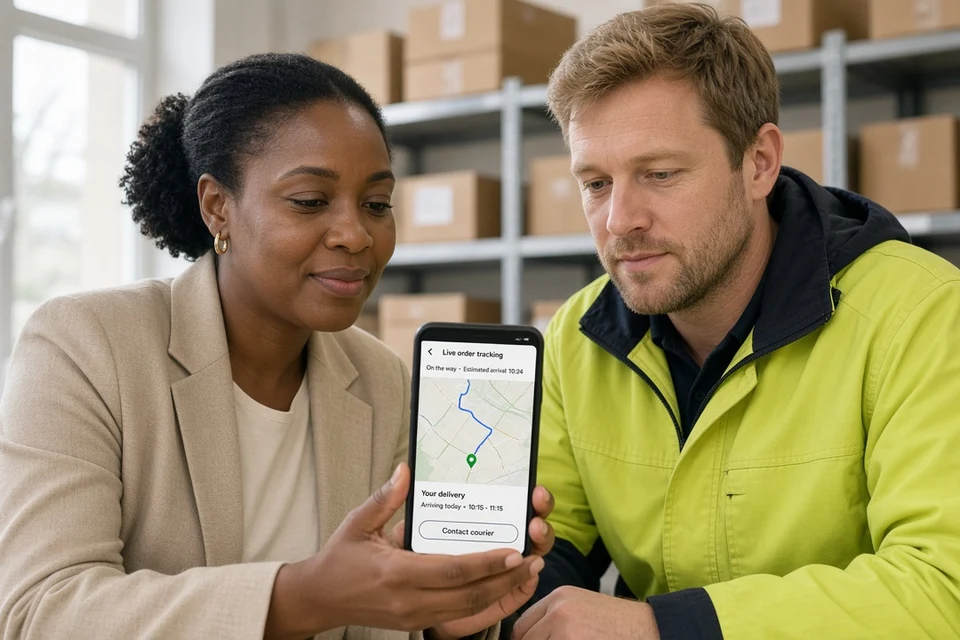
On-demand delivery apps have become an important part of the UK's digital economy, connecting customers with restaurants, retailers, grocery stores, pharmacies, courier services, and other businesses through convenient delivery platforms.
However, building an on-demand delivery application involves more than developing a customer-facing mobile app. Most platforms require separate interfaces for customers, delivery partners, and administrators, along with real-time tracking, payments, notifications, location services, order management, and backend infrastructure.
The on-demand delivery app development cost in the UK can vary significantly depending on the type of delivery service, feature complexity, number of platforms, integrations, technology choices, and development requirements. A simple application may require a smaller investment, while a feature-rich marketplace with advanced tracking and multiple user panels can require a substantially larger budget.
Businesses planning on-demand delivery app development in the UK should therefore define the required features and business model before estimating the overall investment. For the wider on-demand category, see our guide to on-demand app development in the UK.
Key Takeaways
- Development costs vary by complexity: On-demand delivery app development in the UK can range from £4,000 to £50,000+, depending on features, platforms, integrations, and technical requirements.
- User panels affect the budget: Customer, driver, vendor, and admin interfaces each add development, testing, and backend requirements.
- Advanced features increase costs: Real-time tracking, route optimisation, automated dispatch, analytics, and third-party integrations require additional development effort.
- An MVP can reduce initial investment: launching essential functionality first allows businesses to validate the concept before adding advanced capabilities.
- Planning improves cost control: Defining features, technology, integrations, and testing requirements early can reduce unexpected development expenses.
How Much Does On-Demand Delivery App Development Cost in the UK?
The cost of developing an on-demand delivery app in the UK can range from approximately £4,000 to £50,000+, depending on the application's complexity, number of user panels, platforms, integrations, design requirements, and advanced functionality.
A basic delivery app with essential ordering and tracking features can be developed toward the lower end of the range. More advanced platforms with separate customer and driver applications, admin dashboards, real-time GPS tracking, online payments, multiple integrations, and sophisticated backend systems can move toward or beyond the higher end.
Estimated Cost by App Complexity
| App Level | Typical Scope | Estimated Cost |
|---|---|---|
| Basic MVP | Essential ordering, user registration, basic tracking, notifications, and simple admin controls | £4,000–£10,000 |
| Standard App | Customer and delivery-partner features, payments, GPS tracking, order management, and enhanced administration | £10,000–£20,000 |
| Advanced Platform | Multiple user panels, live tracking, advanced integrations, analytics, promotions, and automated workflows | £20,000–£35,000 |
| Enterprise Delivery Solution | Multi-service support, complex integrations, advanced analytics, high scalability, and customised infrastructure | £35,000–£50,000+ |
These figures are approximate development estimates rather than fixed prices. The final budget depends on the project's technical scope and whether the business requires native or cross-platform development, custom integrations, advanced backend infrastructure, or additional services. Compare these ranges with the wider mobile app development cost in the UK picture when you are sizing the full product.
What Determines the Cost of Building an On-Demand Delivery App?
The development budget for an on-demand delivery app depends on more than the number of features. The business model, technical architecture, user roles, platform choices, integrations, and design requirements can all influence the final investment.
1. App Type and Business Model
The type of delivery service has a direct impact on development complexity. A simple courier application may require different workflows from a food delivery marketplace or a multi-vendor grocery platform.
Businesses planning on-demand delivery app development in the UK should define their delivery model, target users, order workflow, and operational requirements before estimating development costs.
For example, food delivery apps may need restaurant menus, item customisation, order preparation updates, and delivery assignment, while courier platforms may require parcel dimensions, pickup scheduling, and proof-of-delivery functionality.
2. Feature Complexity
Basic features such as registration, profile management, search, ordering, and notifications are relatively straightforward compared with advanced capabilities.
Real-time driver tracking, automated dispatching, dynamic pricing, route optimisation, in-app chat, loyalty programmes, and AI-powered recommendations can require additional backend logic, APIs, testing, and infrastructure.
3. Number of User Panels
Many delivery platforms require more than one application interface. A typical solution may include a customer app, delivery-partner app, vendor interface, and admin dashboard.
Each panel introduces additional screens, workflows, permissions, testing requirements, and backend functionality, increasing the overall development effort.
4. Platform Selection
Building for iOS and Android separately can require additional development resources. Businesses can also consider cross-platform technologies when appropriate to share parts of the codebase.
The choice should be based on the target audience, required device capabilities, performance expectations, and long-term product strategy.
5. UI/UX Design Requirements
A simple delivery app with standard screens generally requires less design work than a highly customised platform with interactive maps, personalised dashboards, advanced search, animations, and multiple user journeys.
6. Third-Party Integrations
Integrations can significantly affect both development effort and ongoing maintenance. An on-demand delivery platform may connect with:
- Payment gateways
- GPS and mapping services
- SMS and email providers
- Push notification systems
- Customer relationship management platforms
- Analytics tools
- Restaurant or retail management systems
- Accounting and reporting software
The complexity of these integrations depends on the number of systems involved and how much data needs to be exchanged between them.
Businesses planning on-demand app development in the UK should therefore define integration requirements early so they can be included accurately in the project scope and budget.
On-Demand Delivery App Types You Can Build in the UK for Different Business Needs
On-demand delivery covers several business models, and each type requires a different combination of features, workflows, and integrations. Choosing the right model early can help businesses define the product scope and estimate development requirements more accurately.
Food Delivery Apps
Food delivery platforms connect customers with restaurants and delivery partners. They typically require restaurant listings, menus, item customisation, order placement, online payments, delivery tracking, ratings, and order-status updates.
More advanced platforms may also include restaurant management tools, scheduled deliveries, promotional campaigns, and automated driver assignment. Dedicated food delivery app builds often sit toward the higher end once menus and dispatch are treated as core.
Grocery Delivery Apps
Grocery delivery applications are designed for supermarkets, grocery stores, and multi-vendor marketplaces. Along with standard ordering and payment features, they may need product categories, inventory management, substitutions, delivery slots, and location-based availability.
Real-time inventory synchronization can increase backend complexity when the application connects with existing retail or warehouse systems. See also our guide to grocery and food delivery website development in the UK.
Courier and Parcel Delivery Apps
Courier platforms focus on transporting documents, parcels, and other items between locations. They commonly require pickup and drop-off management, delivery scheduling, GPS tracking, driver assignment, delivery status updates, and proof of delivery.
Medicine Delivery Apps
Pharmacy and medicine delivery platforms require additional attention to product information, order processing, customer verification, and delivery workflows. Depending on the business model and applicable requirements, the platform may also need prescription-related functionality and secure handling of customer information.
Retail and E-commerce Delivery Apps
Retail delivery applications allow customers to purchase products from stores or online marketplaces and arrange delivery to a selected location.
These platforms may require catalogue management, inventory synchronization, shopping carts, payments, order tracking, delivery scheduling, returns management, and integration with existing e-commerce or ERP systems.
Choosing the Right Delivery Model
The type of delivery service you choose will influence the application's feature set, backend architecture, integrations, and overall budget. A business planning an on-demand app development company UK project should therefore define the target market, delivery workflow, user roles, and revenue model before finalising the technical scope.
Essential Features That Influence On-Demand Delivery App Cost
The features included in an on-demand delivery application directly affect development effort, backend complexity, testing requirements, and overall cost. A focused MVP can keep the initial investment manageable, while advanced functionality can be introduced as the platform grows.
| Feature | What It Does | Cost Impact |
|---|---|---|
| User Registration & Profiles | Allows customers, drivers, and vendors to create and manage accounts | Low |
| Search & Filters | Helps users quickly find products, restaurants, stores, or services | Low–Medium |
| Order Management | Supports cart creation, order placement, updates, cancellations, and history | Medium |
| Online Payments | Enables secure card, wallet, and other digital payment methods | Medium |
| GPS & Live Tracking | Shows driver location and delivery progress in real time | Medium–High |
| Driver Assignment | Matches available delivery partners with new orders | Medium–High |
| Push Notifications | Sends order, payment, delivery, and promotional updates | Low–Medium |
| Ratings & Reviews | Allows customers to review vendors and delivery partners | Low |
| Admin Dashboard | Provides control over users, orders, payments, content, and reports | Medium |
| Analytics & Reporting | Tracks sales, delivery performance, customer activity, and operational metrics | Medium–High |
| Route Optimisation | Helps drivers plan efficient delivery routes | High |
| In-App Chat | Supports communication between customers, vendors, and delivery partners | Medium |
| Multi-Vendor Management | Allows multiple businesses or sellers to operate on one platform | High |
| Loyalty & Promotions | Supports discounts, coupons, rewards, and customer retention | Medium |
Customer-Facing Features
The customer application generally includes registration, location selection, service or product discovery, cart management, checkout, payment, order tracking, notifications, ratings, and order history.
A simple MVP may only require the essential customer journey, while a larger platform can add personalised recommendations, loyalty programmes, scheduled deliveries, multiple payment options, and advanced search.
Delivery Partner Features
The driver or delivery-partner interface can include order acceptance, navigation, pickup and drop-off details, status updates, earnings information, delivery history, and proof-of-delivery tools.
Real-time location sharing and automated delivery assignment can increase development complexity because they require continuous communication between the driver application, backend, maps, and customer interface.
Vendor and Business Features
For multi-vendor platforms, businesses may need dashboards for managing products or menus, inventory, pricing, incoming orders, promotions, availability, and delivery status.
These functions can add significant backend and administrative requirements, especially when vendors need integration with their existing systems.
Admin and Management Features
The admin panel provides centralized control over users, vendors, delivery partners, transactions, orders, complaints, promotions, reports, and application settings.
For larger platforms, administrators may also require role-based permissions, operational analytics, automated alerts, dispute management, and audit logs.
Real-Time Tracking and Notifications
Live GPS tracking and automated notifications are among the features that can increase technical complexity. The platform must continuously process location data and communicate status changes between different users.
This is why businesses considering mobile app testing in the UK should test tracking accuracy, notification delivery, network interruptions, device compatibility, and other real-world conditions before launch.
Technology Stack for On-Demand Delivery App Development
The technology stack forms the technical foundation of an on-demand delivery application. The right combination of mobile frameworks, backend technologies, databases, APIs, cloud infrastructure, and development tools can improve performance and support future scalability.
| Technology Layer | Common Options | Purpose |
|---|---|---|
| iOS Development | Swift, SwiftUI | Building the iOS customer, vendor, or driver application |
| Android Development | Kotlin, Jetpack Compose | Developing Android applications |
| Cross-Platform | Flutter, React Native | Building applications for multiple platforms with shared code |
| Backend | Node.js, Python, Java | Managing business logic, APIs, orders, users, and integrations |
| Database | PostgreSQL, MySQL, MongoDB | Storing customer, order, payment, product, and delivery data |
| Cloud Infrastructure | AWS, Microsoft Azure, Google Cloud | Hosting applications, databases, storage, and backend services |
| Maps & Location | Google Maps Platform, Mapbox | Location search, navigation, distance calculation, and tracking |
| Payments | Stripe, Adyen, PayPal | Processing online payments and transaction-related operations |
| Notifications | Firebase Cloud Messaging, Apple Push Notification Service | Sending real-time order and delivery updates |
| Analytics | Firebase Analytics, Google Analytics | Monitoring user behaviour and application performance |
How Long Does It Take to Develop an On-Demand Delivery App in the UK?
The development timeline for an on-demand delivery app in the UK can range from approximately 4 weeks to 6+ months, depending on the application's complexity, number of user panels, integrations, platform choices, and testing requirements.
A basic MVP with a limited feature set can reach an initial release relatively quickly, while a multi-vendor platform with advanced tracking, complex integrations, and customised workflows will require considerably more development and testing.
| App Type | Development Scope | Approximate Timeline |
|---|---|---|
| Basic MVP | Core ordering, profiles, basic tracking, notifications, and admin features | 4–8 weeks |
| Standard Delivery App | Customer and driver apps, payments, GPS, order management, and backend APIs | 2–3 months |
| Advanced Platform | Multiple user panels, live tracking, integrations, analytics, and advanced workflows | 3–5 months |
| Enterprise Delivery Platform | Multi-vendor operations, complex integrations, high scalability, customised infrastructure, and extensive testing | 5–6+ months |
What Can Extend the Development Timeline?
Several factors can increase the time required to complete the project:
- Developing separate native iOS and Android applications
- Supporting multiple customer, vendor, driver, and admin interfaces
- Integrating payment, mapping, CRM, ERP, or other external systems
- Implementing real-time GPS tracking and automated dispatching
- Building advanced analytics and reporting
- Conducting extensive security and performance testing
- Migrating data from existing business systems
- Requiring highly customised UI/UX designs
Planning the Project Around an MVP
Businesses can shorten the initial development cycle by launching an MVP with only the most important features. Core ordering, payment, delivery management, notifications, and basic tracking can be introduced first, while advanced features are added after the product is validated.
How to Reduce On-Demand Delivery App Development Costs Without Compromising Quality
Building an on-demand delivery app does not always require a large initial investment. Businesses can control development expenses by prioritising essential functionality and making practical technology and planning decisions.
Start With a Focused MVP
Launch the application with core features such as registration, ordering, payments, delivery management, notifications, and basic tracking.
Prioritise High-Value Features
Not every feature needs to be available at launch. Businesses should identify the functions that directly support customers, delivery partners, and daily operations.
Features such as advanced analytics, loyalty systems, AI recommendations, and complex automation can be added later.
Choose Cross-Platform Development When Suitable
Using frameworks such as Flutter or React Native can allow businesses to share parts of the codebase between iOS and Android.
Use Reliable Third-Party Services
Building every service from scratch can increase development time and costs. Existing providers can be used for payments, maps, notifications, analytics, authentication, and other common requirements.
Keep UI/UX Practical
A highly customised interface can require additional design and development work. A clean, user-friendly design focused on important actions can provide a strong experience without unnecessary visual complexity.
Plan Integrations Early
Unexpected integration requirements can increase both cost and delivery time. Businesses should identify payment gateways, mapping services, CRM systems, inventory platforms, and other required integrations before development begins.
Test Throughout Development
Testing problems late in the project can require expensive rework. Continuous testing of functionality, payments, tracking, APIs, and different devices can help identify issues earlier.
Businesses can also compare mobile app development costs in the UK estimates across different development approaches before selecting the most suitable technology and project scope.
Build in Phases
A phased development strategy allows businesses to spread investment over time. After the initial release, new features can be prioritised according to customer feedback, operational requirements, and business growth.
Conclusion
Developing an on-demand delivery app in the UK requires careful planning around features, user roles, technology, integrations, and scalability. The estimated investment can start at around £4,000 for a basic MVP and exceed £50,000 for a complex delivery platform.
Businesses should focus on the functionality that directly supports their target customers and delivery operations rather than trying to include every possible feature at launch. A phased development strategy can make it easier to manage both budget and product growth.
Choosing the right technology stack, planning integrations early, testing the application thoroughly, and working with an experienced on-demand app development company can help create a reliable platform that is easier to scale and maintain as the business grows.
Frequently Asked Questions
1. How much does it cost to develop an on-demand delivery app in the UK?
The cost can range from approximately £4,000 to £50,000+, depending on features, platforms, integrations, and overall complexity.
2. How long does it take to build an on-demand delivery app?
A basic MVP may take around 4–8 weeks, while an advanced or enterprise platform can require 3–6+ months.
3. What features does an on-demand delivery app need?
Common features include user registration, order management, online payments, GPS tracking, notifications, driver assignment, ratings, and an admin dashboard.
4. Can I build an on-demand delivery app for both iOS and Android?
Yes. Businesses can use native development or cross-platform technologies such as Flutter or React Native, depending on their requirements.
5. What factors affect on-demand delivery app development cost?
The main factors include app complexity, number of user panels, platform selection, UI/UX requirements, integrations, real-time tracking, security, and backend infrastructure.
6. How can I reduce on-demand delivery app development costs?
Starting with an MVP, prioritising essential features, using suitable third-party services, choosing an efficient technology stack, and developing the app in phases can help control costs.
7. How do I choose an on-demand app development company in the UK?
Review the company's relevant experience, technical expertise, previous projects, development approach, communication process, testing practices, and post-launch support before making a decision.