
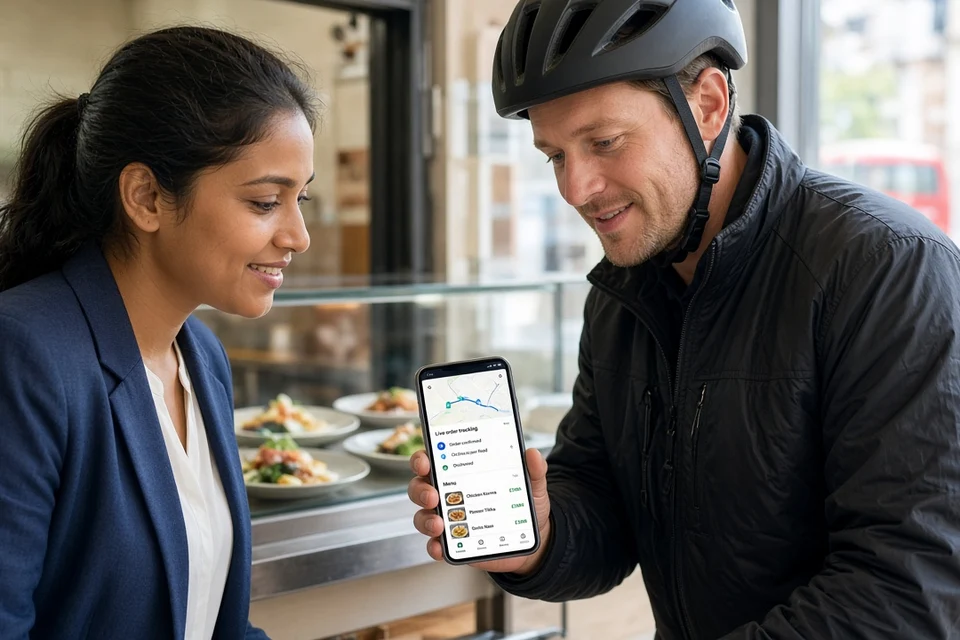
Food delivery platforms have become an important part of the UK's digital economy, connecting customers with restaurants and delivery partners through mobile applications. A Deliveroo-like platform needs to manage more than online food ordering, as it must coordinate customers, restaurants, delivery partners, payments, orders, notifications, and real-time delivery tracking.
The overall development cost depends on the platform's complexity, number of applications, features, integrations, design requirements, backend architecture, and development team. A basic food delivery MVP will require a different budget from a large multi-vendor platform supporting advanced analytics, real-time tracking, promotions, and complex restaurant and delivery operations.
This guide explains the major costs involved in building an app like Deliveroo in the UK, including development scope, features, integrations, ongoing expenses, and the factors that can influence the final investment. For related scopes, see our guides to on-demand delivery app development cost and on-demand delivery app development in the UK.
Key Takeaways
- A Deliveroo-like platform requires multiple components: customer, restaurant, delivery partner, and admin applications, all contributing to the overall development scope.
- UK development costs vary by complexity: A Deliveroo-like app can cost approximately £10,000 to £100,000+, depending on features, integrations, platforms, and scalability.
- Real-time logistics increase complexity: GPS tracking, route management, delivery assignment, and live order updates require additional backend infrastructure.
- Third-party services affect the budget: Payments, maps, POS systems, notifications, analytics, and other APIs add development and recurring costs.
- Ongoing expenses continue after launch: Hosting, maintenance, security, payment processing, APIs, and feature improvements should be included in the long-term budget.
What Does a Deliveroo-Like App Include? Essential Features and Functionalities
A Deliveroo-like platform is usually made up of multiple connected applications and backend systems rather than a single mobile app. Each part serves a different group of users and contributes to the overall development scope.
Customer App
The customer application allows users to discover restaurants, browse menus, place orders, make payments, track deliveries, and manage their accounts.
Typical functionality includes:
- Restaurant search and filters
- Menu browsing
- Cart and checkout
- Multiple payment options
- Order tracking
- Ratings and reviews
- Offers and promotions
- Push notifications
Restaurant Partner App or Dashboard
Restaurants need a separate interface to manage menus, prices, availability, incoming orders, preparation times, and business information.
The platform may also provide sales reports, customer insights, promotional tools, and order-history management.
Delivery Partner App
Delivery partners require tools for accepting delivery requests, viewing routes, updating order status, communicating with customers or restaurants, and managing their availability.
GPS tracking, navigation integration, earnings information, and delivery history can also be included.
Admin Panel
The administrator dashboard manages the overall marketplace. It can include restaurant onboarding, delivery-partner management, customer accounts, order monitoring, commissions, promotions, disputes, payments, reports, and platform settings.
Backend and Database
The backend connects all user applications and handles authentication, orders, payments, restaurant data, delivery assignments, notifications, real-time tracking, and business logic.
Real-Time Delivery Infrastructure
A food delivery platform may require location services, mapping APIs, route calculations, live order-status updates, and communication between customers, restaurants, and delivery partners.
Businesses planning food delivery app development in the UK should therefore budget for the complete ecosystem rather than only the customer-facing application.
How Much Does It Cost to Build an App Like Deliveroo in the UK?
The cost to build an app like Deliveroo in the UK can range from approximately £10,000 to £100,000+, depending on the number of applications, features, integrations, design complexity, backend architecture, and scalability requirements.
A basic MVP with essential ordering and delivery functionality will cost considerably less than an enterprise-level platform supporting multiple regions, advanced analytics, real-time logistics, loyalty programs, and complex integrations.
| Development Scope | Typical Features | Estimated Cost | Approx. Timeline |
|---|---|---|---|
| Basic MVP | Customer app, restaurant panel, basic delivery management, payments, admin dashboard | £10,000–25,000 | 2–3 months |
| Standard Platform | Advanced search, offers, reviews, live tracking, restaurant dashboard, delivery app, notifications | £25,000–50,000 | 3–5 months |
| Advanced Platform | Real-time logistics, analytics, loyalty, multiple integrations, advanced admin tools | £50,000–75,000 | 5–7 months |
| Enterprise Platform | Multi-region support, high scalability, sophisticated delivery management, automation, advanced analytics | £75,000–100,000+ | 7–12+ months |
The final food delivery app development cost in the UK can vary further based on whether the business uses cross-platform or native development, the number of third-party services, and the level of customization required. Compare these figures with wider mobile app development cost in the UK ranges when sizing the full product.
Where Does the Food Delivery App Development Budget Go?
The total budget for a Deliveroo-like platform is divided across several components because the system needs to support customers, restaurants, delivery partners, and administrators.
| Cost Component | What It Covers | Cost Impact |
|---|---|---|
| Customer App | Restaurant discovery, menus, cart, checkout, orders, tracking, reviews | Medium to High |
| Restaurant App/Panel | Menu management, order handling, availability, offers, reports | Medium |
| Delivery Partner App | Delivery requests, navigation, status updates, earnings, location tracking | Medium to High |
| Admin Dashboard | Users, restaurants, drivers, orders, commissions, reports, disputes | Medium |
| Backend & APIs | Authentication, databases, order management, business logic, notifications | High |
| UI/UX Design | User flows, screens, responsive layouts, prototypes, design system | Medium |
| Third-Party Integrations | Payments, maps, notifications, analytics, communication services | Medium to High |
| Testing & Deployment | Functional testing, security testing, performance checks, app deployment | Medium |
Customer Application
The customer-facing app generally requires the largest share of frontend development because it includes restaurant discovery, search, menus, checkout, payments, order tracking, reviews, and notifications.
Restaurant Platform
Restaurant partners need tools for managing menus, prices, availability, incoming orders, preparation times, and promotional offers. A simple restaurant dashboard will cost less than a feature-rich partner application.
Delivery Partner Application
Delivery functionality can increase development complexity because it may involve GPS tracking, route navigation, real-time location updates, delivery status management, and earnings information.
Backend Infrastructure
The backend connects all parts of the platform and manages users, restaurants, orders, payments, delivery assignments, notifications, and business rules. A scalable backend is particularly important for a growing multi-vendor food delivery marketplace.
Integrations and Third-Party Services
Payment gateways, mapping services, push notifications, SMS, analytics, and other external services can add both development and recurring operational costs.
Businesses comparing on-demand delivery app development in the UK should therefore consider the complete platform ecosystem rather than estimating the budget from the customer app alone.
Key Features That Affect App Development Cost and Overall Project Budget
The functionality included in a Deliveroo-like platform has a direct effect on development effort and overall cost. Basic ordering features are relatively straightforward, while real-time logistics, personalization, and advanced marketplace tools require more complex development.
Restaurant Discovery and Search
Restaurant search, filters, sorting, cuisine categories, ratings, location-based results, and personalized recommendations can increase frontend, backend, and search-development requirements.
Online Ordering and Checkout
The ordering system needs to manage cart creation, item customization, taxes, delivery charges, discounts, payment processing, and order confirmation.
Real-Time Order Tracking
Live tracking requires location services, maps, GPS updates, backend communication, and real-time status synchronization between customers, restaurants, and delivery partners.
Delivery Management
Automated driver assignment, route optimization, delivery zones, availability management, and real-time location updates can significantly increase platform complexity.
Restaurant Management
Features such as menu management, inventory availability, order acceptance, preparation-time updates, promotions, and restaurant analytics add to the partner-side development scope.
Payments and Refunds
Multiple payment methods, saved payment options, refunds, failed transactions, and transaction-status management require secure payment integrations and additional testing.
Ratings, Reviews, and Customer Support
Ratings, reviews, complaints, chat, helpdesk functionality, and order-related support tools add additional workflows and administrative requirements.
Offers and Loyalty Programmes
Coupons, promotional campaigns, referral programs, reward points, membership plans, and personalized offers can require additional business logic and database management.
Notifications and Communication
Push notifications, SMS, email, and in-app alerts can keep customers, restaurants, and delivery partners updated about important order events.
Analytics and Reporting
Advanced dashboards can track orders, revenue, customer behavior, restaurant performance, delivery efficiency, cancellations, and other marketplace metrics.
AI and Automation
AI-based recommendations, demand forecasting, intelligent customer support, fraud detection, or delivery optimization can increase both development complexity and infrastructure requirements. Our guide to AI development in the UK covers how those layers typically affect scope.
Businesses evaluating a food delivery app development company in London, UK, should therefore compare providers based on their ability to handle these advanced capabilities, not just basic app development.
Third-Party Integrations That Increase App Development Cost and Project Complexity
Third-party integrations can significantly affect the cost of a food delivery platform because each external service requires API integration, authentication, testing, error handling, and ongoing maintenance.
| Integration | Purpose | Cost Impact |
|---|---|---|
| Payment Gateways | Processes online payments, refunds, and transaction status | Medium |
| Maps & GPS | Location search, route planning, and live delivery tracking | Medium to High |
| Push Notifications | Sends order and delivery updates | Low to Medium |
| SMS & Email | OTPs, confirmations, and customer communication | Low to Medium |
| Restaurant POS Systems | Synchronizes menus, orders, and restaurant operations | Medium to High |
| Analytics Platforms | Tracks user behavior, orders, and business performance | Low to Medium |
| Customer Support Tools | Supports chat, tickets, and customer-service workflows | Low to Medium |
| Identity & Verification Services | Supports partner onboarding and verification | Medium |
Payment Integrations
Payment gateways allow customers to pay for orders and can also support refunds, failed transactions, saved payment methods, and transaction-status updates.
Maps and Location Services
Maps and GPS services support restaurant discovery, delivery zones, address selection, navigation, estimated delivery times, and real-time courier tracking.
Restaurant POS Integration
Larger restaurants may already use point-of-sale systems. Connecting these systems with the delivery platform can synchronize menus, availability, incoming orders, and order statuses. See also our guide to POS integration with ecommerce stores for UK retailers.
Communication Services
SMS, email, and push-notification services can be used for OTP verification, order confirmations, delivery updates, promotions, and customer communication.
Analytics and Customer Support
Analytics tools help businesses understand customer behavior and platform performance, while support integrations can help teams manage complaints, refunds, and order-related issues.
Businesses planning a feature-rich platform should include both integration development costs and recurring third-party service fees when calculating the overall project budget.
Factors Affecting Deliveroo-Like App Development Cost and Project Complexity
The final development budget depends on more than the number of features. Technical architecture, platform requirements, integrations, design, and business scale can all affect the total investment.
Number of Applications
A platform with separate customer, restaurant, delivery partner, and admin applications requires more development than a single customer-facing app.
Platform Choice
Building for both iOS and Android can increase development and testing requirements. Cross-platform development may reduce some duplicated work, while native development may be preferred for certain performance or device-specific requirements.
UI/UX Complexity
A basic ordering experience requires less design work than a highly customized platform with personalized recommendations, interactive maps, advanced restaurant discovery, and complex checkout flows.
Real-Time Features
Live GPS tracking, instant order updates, delivery assignment, chat, and real-time notifications require additional backend infrastructure and communication systems.
Backend and Scalability
A platform serving a small number of restaurants has different infrastructure needs from one handling thousands of restaurants, customers, delivery partners, and daily orders.
Payment and API Integrations
Every payment provider, mapping service, restaurant POS, notification platform, or external API can add development, testing, and maintenance requirements.
Security Requirements
Authentication, payment security, access controls, encryption, fraud prevention, monitoring, and regular security testing can increase both development effort and ongoing operating costs.
Development Team
The location, experience, technical specialization, and size of the development team can influence project rates. Businesses that choose to hire mobile app developers in the UK should evaluate both the hourly or project rate and the team's relevant food-delivery experience.
Ongoing Maintenance
After launch, businesses need to budget for bug fixes, operating-system updates, security improvements, infrastructure, API changes, monitoring, and new features.
Deliveroo-Like App Cost vs. Other Food Delivery Solutions: Pricing and Feature Comparison
The development cost of a food delivery platform depends heavily on its business model and operational complexity. A single-restaurant ordering app usually requires fewer features than a multi-vendor marketplace like Deliveroo.
| Platform Type | Typical Scope | Relative Cost |
|---|---|---|
| Single-Restaurant App | Menu, ordering, payments, delivery, customer account | Low to Medium |
| Multi-Restaurant App | Multiple restaurants, customer app, partner panel, delivery management | Medium to High |
| Deliveroo-Like Marketplace | Customers, restaurants, delivery partners, real-time tracking, payments, admin, analytics | High |
| Enterprise Food Delivery Platform | Multi-region operations, advanced logistics, automation, analytics, complex integrations | Very High |
Single-Restaurant vs. Multi-Restaurant
A restaurant-specific application generally has a smaller operational scope because it manages one business. A multi-vendor platform requires restaurant onboarding, commissions, partner dashboards, vendor management, and marketplace workflows.
Food Delivery App vs. On-Demand Delivery Platform
A standard food delivery platform focuses primarily on restaurant orders, while a broader on-demand platform may support groceries, retail products, pharmacies, or other delivery categories. Supporting multiple categories can introduce additional workflows and integrations. See our on-demand delivery app development cost guide for that wider category.
Standard vs. Enterprise Platform
An enterprise solution may require multiple regions, currencies, advanced logistics, large-scale infrastructure, sophisticated analytics, and integrations with existing business systems. These requirements can significantly increase both development and operating costs.
The actual budget should therefore be based on the platform's features, users, integrations, operational model, and scalability requirements, rather than the app category alone.
Ongoing Costs After Launch: What Businesses Should Plan For
The initial development budget is only part of the investment required to operate a food delivery platform. Businesses should also plan for recurring technical, operational, and third-party expenses.
| Ongoing Cost | What It Covers |
|---|---|
| Cloud & Hosting | Servers, databases, storage, bandwidth, backups, and monitoring |
| App Maintenance | Bug fixes, updates, performance improvements, and technical support |
| Payment Processing | Transaction and payment-provider charges |
| Maps & Location Services | GPS, mapping, routing, and location API usage |
| SMS & Notifications | OTPs, alerts, emails, and customer communication |
| Security | Monitoring, vulnerability testing, certificates, and security updates |
| Third-Party APIs | Analytics, POS, support, verification, and other external services |
| Feature Development | New functionality, integrations, and platform improvements |
Businesses should also account for customer support, marketing, restaurant onboarding, delivery operations, and other business expenses that are separate from software development.
For a clearer budget, companies should compare these recurring expenses with the initial food delivery app development cost in the UK rather than considering development as a one-time investment. Ongoing upkeep often follows similar patterns to mobile app maintenance cost in the UK.
How to Reduce Food Delivery App Development Costs Without Compromising Quality
Businesses can control the initial investment by focusing on essential functionality and expanding the platform after validating the market.
Start With an MVP
Launch with core features such as restaurant discovery, ordering, payments, delivery management, tracking, and an admin panel. Advanced features can be added later.
Prioritize High-Value Features
Focus the first release on features that directly support orders, payments, restaurant operations, and deliveries. Complex loyalty programs, AI tools, and advanced analytics can be introduced in later phases.
Use Cross-Platform Development
A cross-platform framework can reduce some duplicated development work when the same application needs to support both iOS and Android.
Use Proven Third-Party Services
Payment gateways, maps, notifications, analytics, and communication APIs can reduce the need to develop standard infrastructure from scratch.
Plan Integrations Early
Identifying required integrations before development can prevent expensive architectural changes and reduce unexpected development work.
Build in Phases
Businesses can release the platform in stages, adding restaurant tools, advanced delivery optimization, personalization, and additional integrations as usage increases.
Choose the Development Team Carefully
Compare providers based on technical expertise, relevant experience, scope, maintenance terms, and communication rather than choosing solely on the lowest quote.
A focused approach can help businesses manage on-demand delivery app development costs in the UK while still creating a reliable foundation for future expansion.
Conclusion
Building an app like Deliveroo in the UK requires investment across customer experiences, restaurant management, delivery operations, backend infrastructure, payments, real-time tracking, and administration.
The final budget depends on the platform's complexity, number of applications, feature set, integrations, development approach, and scalability requirements. Businesses can manage the initial investment by launching an MVP, prioritizing essential functionality, and expanding the platform based on customer and market demand.
Planning for ongoing infrastructure, maintenance, security, and third-party service costs is equally important. A well-designed and scalable platform can provide the technical foundation needed to support growing restaurant networks, delivery operations, and customer demand.
Frequently Asked Questions
1. How much does it cost to build an app like Deliveroo in the UK?
A Deliveroo-like app can cost around £10,000 to £100,000+, depending on features, integrations, platforms, and complexity.
2. How long does it take to build a Deliveroo-like app?
A basic MVP may take 2–3 months, while an advanced platform can take 7–12+ months.
3. What apps are needed for a Deliveroo-like platform?
Typically, the platform includes a customer app, restaurant app or dashboard, delivery partner app, and admin panel.
4. What features increase food delivery app development cost?
Real-time GPS tracking, route optimization, multiple payment methods, loyalty programs, advanced analytics, AI, and complex integrations can increase development costs.
5. What are the ongoing costs after launch?
Common expenses include hosting, maintenance, payment processing, maps, SMS, third-party APIs, security, and future feature development.
6. Can I reduce the cost of building a food delivery app?
Yes. Starting with an MVP, using cross-platform development, integrating proven third-party services, and developing advanced features in phases can help control the initial budget.