
Custom Furniture eCommerce Website Development for UK Retailers: Cost & Development Guide
The UK furniture market keeps moving online. Shoppers now browse sofas, beds, and dining sets on their phones before they ever visit a store.
A generic template site cannot keep up with that shift. A custom furniture ecommerce website is built around your products, your delivery rules, and your customers.
This guide walks through the real cost, the features that matter, and the development process step by step, so you know exactly what you are paying for before you sign anything.
Why UK Furniture Retailers Are Investing in Custom Furniture eCommerce Website Development
Buying habits have changed fast. Customers want to see fabric swatches, compare dimensions, and check delivery slots before they add a sofa to the basket. Many furniture brands now sell to both trade buyers and everyday shoppers on the same site, which off-the-shelf platforms handle poorly.
The UK furniture e-commerce market is forecast to keep growing through 2030, according to Statista.
A few reasons this trend keeps building:
- Shoppers expect a digital showroom, not a basic product list
- B2B and direct-to-consumer orders now sit on the same platform
- Delivery expectations have gone up, especially for bulky items
Top Custom Furniture eCommerce Website Development Benefits for UK Retail Businesses
A custom build is not about looking fancy. It is about running the business better. Retailers who move away from rigid templates usually see fewer abandoned carts and fewer support calls about delivery dates.
| Benefit | Business Impact |
|---|---|
| Higher conversions | Product pages built around dimensions and fabric choices convert better than generic layouts |
| Scalable catalogues | New collections and SKUs get added without breaking the site |
| Better SEO | Clean code and fast pages help pages rank higher in search |
| Lower maintenance | Fewer plugin conflicts than bloated template stacks |
| Easier integrations | Connects cleanly with ERP, stock, and delivery systems |
| Better customer experience | Buyers can customise a product and see it reflected instantly in price and lead time |
This is why many retailers now work with a custom eCommerce development company instead of stretching a template past its limits.
Furniture eCommerce Website Features Every UK Retailer Needs
Features decide whether a shopper buys or leaves. Furniture is a considered purchase, so the site has to answer questions before the customer even asks them.
Smart Product Catalogue Management
A furniture catalogue is messier than most. One sofa might have ten fabric options, three leg finishes, and two size variants. A proper PIM (product information management) setup keeps SKUs, collections, categories, and variants organised so stock never goes out of sync with what is shown online.
Product Customisation
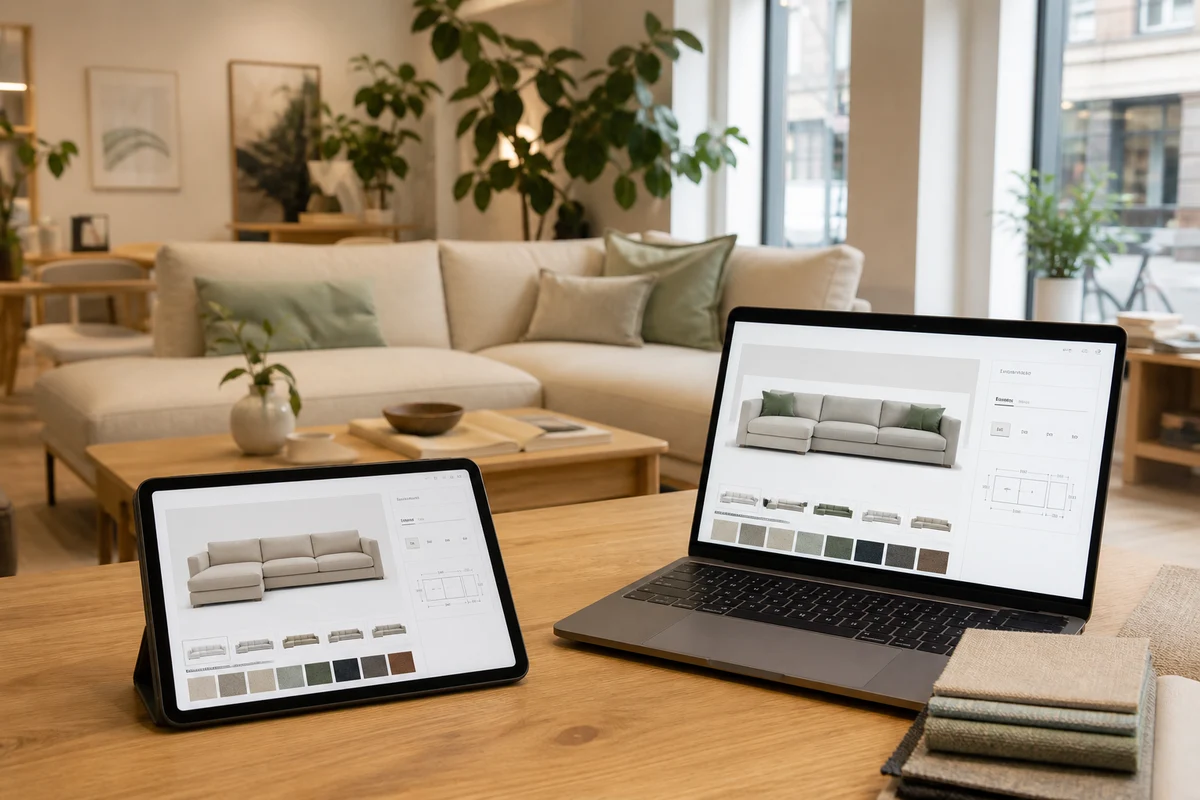
Buyers want to pick the fabric, the colour, the finish, and the exact dimensions before they order. A configurator that updates price and delivery time in real time, based on those choices, cuts down on returns and confused customers asking for made-to-order changes after the sale.
Advanced Search & Filtering
Furniture shoppers filter by size, material, and price range more than almost any other retail category. Faceted search, built on something like Elastic Search, lets customers narrow a catalogue of thousands of products down to five relevant options in seconds. Without it, they leave.
Furniture Delivery Management
Delivery is where furniture ecommerce gets complicated. Large parcel courier rules differ from a normal Royal Mail or DPD parcel. White glove delivery, click and collect, and delivery slot booking all need to sit inside the checkout flow, not bolted on afterwards.
Secure Checkout
Furniture orders carry a higher price tag than most online purchases, so trust at checkout matters. Apple Pay, Google Pay, Stripe, PayPal, and finance options like Klarna all reduce drop-off at the final step.
B2B Features
Trade accounts, minimum order quantities, RFQ forms, bulk pricing, VAT handling, and purchase order support let one website serve both a homeowner and a hotel procurement manager. Account roles keep permissions clean between the two.
| Feature | Business Value | Priority |
|---|---|---|
| Product configurator | Reduces returns, increases order value | High |
| Faceted search | Shortens path to purchase | High |
| Delivery slot booking | Cuts missed-delivery support tickets | High |
| Trade account portal | Opens up B2B revenue | Medium |
| Multi-payment checkout | Reduces cart abandonment | High |
Retailers who want all of this working together usually start with proper eCommerce website development services rather than piecing it together with plugins.
How to Develop a Custom Furniture eCommerce Website for UK Retailers
Good furniture e-commerce projects follow a clear sequence. Skipping steps here is one of the biggest reasons projects go over budget later.
1. Discovery & Business Planning
Define business goals, target buyers, product catalogue, delivery rules, and growth plans before development begins.
Review existing ERP, CRM, POS, warehouse, and payment systems to avoid costly integration issues later.
Teams often discover hidden business rules during workshops, helping create a realistic scope, timeline, and development budget.
2. UX Research & Customer Journey
Study how UK furniture buyers compare products, check dimensions, and choose delivery before completing a purchase.
Plan category pages, product filters, room collections, and buying journeys to reduce friction and improve conversions.
Real customer behaviour shapes navigation, search experience, and checkout flow instead of relying on design assumptions.
3. Wireframing & Information Architecture
Create page layouts showing navigation, product pages, checkout flow, and account areas before visual design starts.
Organise collections, categories, filters, and product hierarchy so customers find furniture faster across large catalogues.
Early wireframes help identify usability issues before development, reducing expensive design changes later.
4. UI Design & Brand Experience
Design a clean interface that highlights furniture images, finishes, colours, dimensions, and lifestyle photography.
Build consistent typography, buttons, icons, and trust signals that strengthen brand credibility across every page.
Furniture retailers often improve buying confidence by making product details easier to scan on desktop and mobile.
5. Frontend & Backend Development
Develop responsive pages, customer accounts, checkout, and product configurators using scalable ecommerce technologies.
Build secure backend systems to manage inventory, pricing, orders, customer data, and business workflows efficiently.
Strong development creates faster page speed, better Core Web Vitals, and a smoother shopping experience.
6. Third-Party Integrations
Connect ERP, CRM, PIM, payment gateways, inventory software, shipping partners, and marketing platforms through secure APIs.
Real-time stock, pricing, and order synchronisation reduces manual work and prevents overselling popular products.
Integration planning becomes critical for retailers managing multiple warehouses or supplier-based inventory.
7. Quality Assurance & Testing
Test every feature, payment method, product option, and checkout journey across different browsers and mobile devices.
Validate website speed, accessibility, security, and Core Web Vitals before opening the store to customers.
One common implementation challenge is launching without full testing, leading to lost sales and customer complaints.
8. Launch & Go Live
Launch the website after final content checks, SEO validation, redirects, analytics setup, and performance monitoring.
Many retailers begin with a controlled rollout to monitor traffic, orders, and customer feedback before full promotion.
A structured launch plan helps detect issues early without disrupting day-to-day business operations.
9. Continuous Optimisation & Growth
Monitor customer behaviour, conversion rates, search terms, and abandoned carts to improve sales over time.
Add new collections, delivery options, AI features, and seasonal campaigns without rebuilding the entire platform.
High-performing furniture websites continue evolving through data, customer feedback, and ongoing platform improvements rather than remaining unchanged after launch.
Retailers who try to save money by skipping the discovery and UX stages often end up needing rework within the first year. Working with a team that can hire expert eCommerce developers for the full process tends to cost less over time than a rushed build.
How Much Does Custom Furniture eCommerce Website Development Cost in the UK?
There is no single fixed price for this. Cost depends on catalogue size, feature list, and how many systems need to connect.
| Project Type | Cost | Timeline | Best For |
|---|---|---|---|
| Basic | £4,000–£10,000 | 4–8 weeks | Small furniture shops with a simple catalogue |
| Growing | £10,000–£20,000 | 2–4 months | Retailers adding customisation and delivery booking |
| Advanced | £20,000–£35,000 | 4–6 months | Multi-brand retailers with B2B accounts |
| Enterprise | £35,000–£50,000+ | 6+ months | Large retailers needing ERP and warehouse integration |
Cost Factors
Design complexity, the number of features, integrations with existing systems, product count, CMS choice, SEO setup, testing depth, and hosting all shift the final number up or down.
Hidden Costs
Maintenance, licence fees, hosting, ongoing support, and staff training rarely show up in the first quote. Ask about them upfront. A full breakdown of the cost of custom eCommerce development in London usually helps set realistic expectations before a project starts.
Choosing the Right Technology for Bespoke Furniture eCommerce Development
Platform choice affects SEO, scalability, and long-term maintenance.
| Platform | SEO | B2B Support | Scalability | Cost | Best Use Case |
|---|---|---|---|---|---|
| Shopify Plus | Good | Moderate | High | Medium | Fast-growing DTC brands |
| Magento (Adobe Commerce) | Strong | Strong | High | Higher | Complex catalogues with B2B |
| WooCommerce | Moderate | Basic | Medium | Low | Small, simple stores |
| Headless Commerce | Strong | Strong | Very High | Higher | Brands wanting full design control |
| Fully Custom | Strong | Fully custom | Very High | Highest | Enterprise retailers with specific workflows |
Many furniture retailers weigh up custom development vs Shopify at this stage, since both can work well depending on catalogue size and budget.
Common Mistakes UK Furniture Retailers Make During eCommerce Website Development
Some mistakes show up again and again across furniture e-commerce projects.
Choosing the Cheapest Developer
A low quote often means limited planning and weak code. Investing in an experienced team reduces rebuilds, delays, and long-term development costs.
Ignoring Delivery Rules
Many projects treat delivery as an afterthought. Plan bulky shipping, white-glove delivery, and delivery slots early to avoid checkout issues.
Poor Product Filtering
Large furniture catalogues become frustrating without smart filters. Add filters for size, material, colour, price, and room to improve product discovery.
Weak SEO Foundations
A beautiful website means little if customers cannot find it. Build technical SEO, clean URLs, schema, and fast pages into the project from day one.
Skipping ERP Integration
Manual stock updates quickly create pricing and inventory errors. Connect your ERP early to keep orders, stock levels, and customer data in sync.
No Conversion Rate Optimisation (CRO)
Traffic alone does not drive sales. Improve product pages, trust signals, and checkout flow regularly to turn more visitors into paying customers.
Ignoring Core Web Vitals
Slow-loading pages increase bounce rates, especially on mobile. Optimise images, code, and server performance to improve speed and search visibility.
A detailed look at custom eCommerce development in London projects shows these mistakes cost far more to fix after launch than to plan around from day one.
Why Ongoing Maintenance Matters After Custom Furniture eCommerce Website Launch
Launch day is the start, not the finish. Security patches, performance checks, and platform updates need regular attention. SEO also needs monitoring, since rankings shift as competitors update their own sites.
New features, like a fresh delivery option or a seasonal collection page, usually get added well after the original build.
Proper eCommerce maintenance and support keeps the site fast, secure, and ranking well for years, not just for the first few months.
Conclusion
Custom furniture ecommerce websites cost more upfront than a template, but they pay that back through better conversions, fewer support headaches, and a site that scales with the catalogue.
Cost depends on catalogue size, features, and integrations, so get a clear breakdown before committing. Planning delivery, customisation, and B2B needs early saves a costly rebuild down the line.
Frequently Asked Questions
1. How much does a custom furniture ecommerce website cost in the UK?
Custom furniture ecommerce websites usually cost £4,000 to £50,000+, depending on features, integrations, product range, and business requirements.
2. How long does furniture ecommerce website development take?
A basic website takes 4–8 weeks. Advanced B2B platforms with ERP and custom features usually need 4–6 months.
3. Magento or Shopify for a furniture ecommerce store?
Magento suits complex B2B stores. Shopify Plus is ideal for faster launches and simpler management. Choose based on your business needs.
4. Can one website support both B2B and retail furniture customers?
Yes. One website can support B2B and retail buyers with trade pricing, RFQs, bulk orders, and a standard online checkout.
5. Is headless commerce worth it for furniture retailers?
Headless commerce offers faster pages and more design freedom. It's best for large furniture brands planning long-term growth. See our headless ecommerce development guide for more detail.
6. What does ongoing maintenance include after launch?
Maintenance covers updates, security, bug fixes, backups, speed checks, and SEO monitoring to keep your website secure and performing well.
7. Does a custom ecommerce website actually help SEO?
Yes. Custom websites improve speed, clean code, and technical SEO, helping furniture stores rank better and deliver a smoother user experience.
8. How does furniture ERP integration work with an ecommerce website?
ERP integration syncs stock, pricing, and orders in real time. It reduces manual work, prevents overselling, and improves order accuracy.