
Key Takeaways
- Voice commerce helps UK retailers improve customer experience with faster, hands-free shopping and simpler product reordering.
- Fast websites, structured data, and voice search SEO are essential for successful voice commerce adoption.
- AI, NLP, and speech recognition power accurate voice search, product discovery, and secure voice shopping.
- UK retailers can start with basic voice search features before investing in full voice commerce solutions.
- Early adoption of voice commerce can increase repeat purchases, customer loyalty, and long-term business growth.
Voice Commerce for UK Retailers: How to Prepare Your eCommerce Store
More UK shoppers are talking to their devices instead of typing. They ask Alexa to reorder milk. They ask Google Assistant to find trainers under £80. This shift is called voice commerce, and it's growing fast.
For UK retailers, this is not a trend to watch from the sidelines. Smart speakers sit in millions of homes from London to Leeds. Mobile assistants sit in every pocket. If your store is not ready for voice, you could lose customers to one that is.
This guide explains what voice commerce means, why it matters, and how to get your eCommerce store ready. You'll get a checklist, practical tips, real UK examples, a cost breakdown, and answers to common questions.
What Is Voice Commerce?
Voice commerce lets people shop using spoken words instead of typing or clicking. A customer speaks to a device. The device understands the request. It finds a product and sometimes completes the purchase, all without a screen.
This is different from traditional online shopping, which needs a keyboard, a mouse, or a screen tap. Voice commerce needs only a voice. That makes it faster for many everyday tasks, especially reorders.
UK retailers have already tested this. Argos was the first UK retailer to launch voice shopping through Google Assistant, letting shoppers reserve items for same-day collection at local stores. ASOS built a voice shopping app called Enki, letting fashion shoppers browse categories by simply talking to Google Assistant. Grocery retailer Ocado rolled out an Alexa skill that lets customers add items to their basket and track orders by voice.
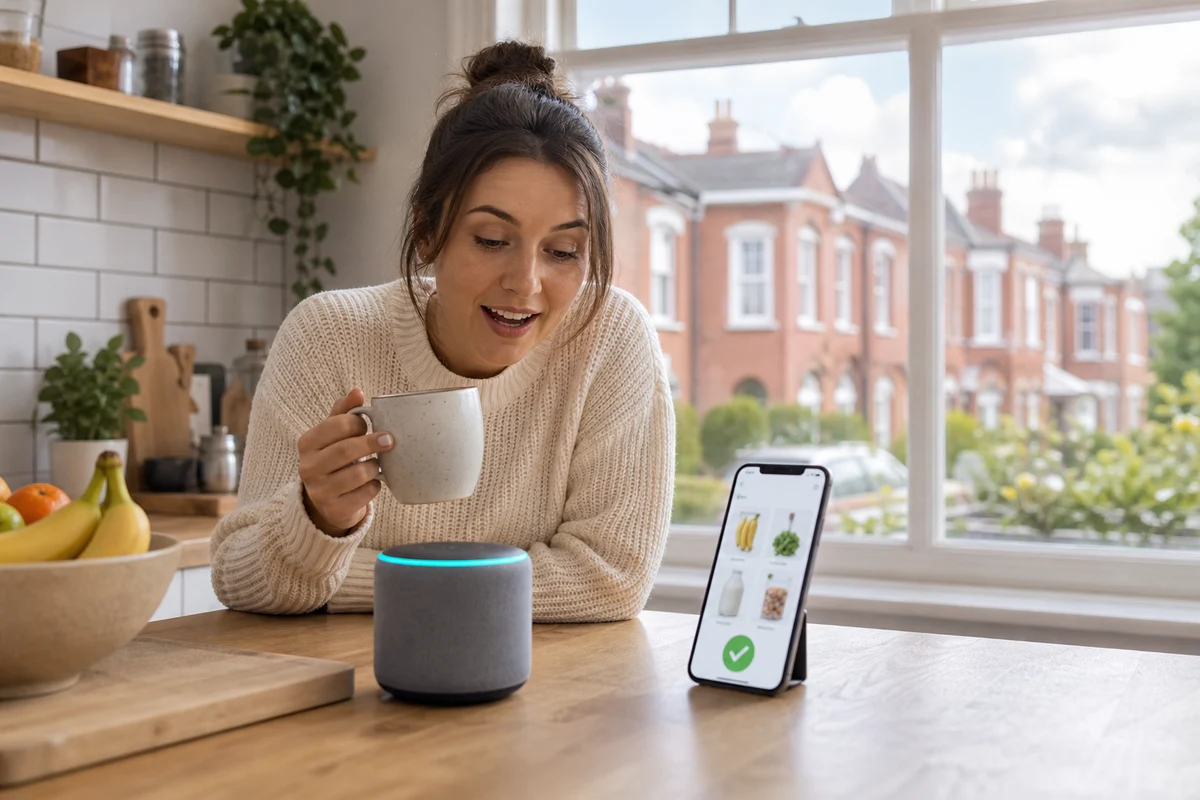
Example: A shopper in Manchester says, "Alexa, order my usual coffee pods." Alexa checks past orders, confirms the product, and places the order. No app. No search bar. Just a sentence.
In practice, most UK retailers don't start with a full voice checkout. They usually start smaller, with voice search or basket-building, then add full ordering once customer demand is clear. That staged approach tends to keep both cost and risk manageable.
Why Voice Commerce Matters for UK Retailers
Customer habits are changing. People want quick answers and quick purchases. They don't always want to open an app or type on a small screen.
Smart speakers are common in UK homes now. Around 1 in 10 UK households already owned a smart speaker device even in the early days of voice retail, and adoption has climbed steadily since, according to retailer research cited by Tesco Labs. Devices like Amazon Echo and Google Nest sit in kitchens across the country, from Bristol to Edinburgh.
Voice shopping also helps with accessibility. Older customers, people with visual impairments, and busy parents all benefit from hands-free shopping. Speaking is often easier than typing, and this ties into the wider shopping journey a customer takes across devices, not just one single visit.
There's also a competitive angle. Retailers who prepare early get a head start on rivals. If you're weighing up whether to build this in-house or bring in outside help, it's worth reading about how to hire an eCommerce developer before committing budget either way.
Market data backs up the urgency. The UK voice commerce market generated a revenue of USD 4,231.5 million in 2024 and is projected to reach USD 17,564.1 million by 2030, a 29% CAGR, per Grand View Research. That's one of the fastest growth rates of any digital retail channel in the country right now.
How Voice Shopping Works for UK eCommerce Stores
Voice commerce follows a simple chain of steps, moving from spoken words to a finished order. This is also where a voice user interface, or VUI, comes into play. A VUI is simply the set of prompts, questions, and responses a customer hears while shopping by voice.
Voice Input
The customer speaks a request to a smart speaker, phone, or smart TV. NLP, search intent, and speech-to-text combine here so a casual sentence like "find running shoes near me" gets turned into something a system can act on.
Natural Language Processing (NLP)
NLP is the AI layer that understands human language, including accents and casual phrasing. It reads the voice input and works out the customer's real intent, filtering out filler words like "um" or "just."
AI-Based Product Matching
Once intent is clear, AI search matches the request against your product feed. It checks titles, descriptions, past orders, and stock. Retailers using artificial intelligence for eCommerce search tend to see fewer "sorry, I couldn't find that" moments during voice sessions.
Voice Responses
The assistant speaks back the results, sometimes asking a follow-up like "same brand as last time?" This short back-and-forth is what separates true conversational commerce from a basic one-line answer.
Secure Checkout
Once confirmed, the order moves to checkout, often using saved payment details or a voice PIN. This step needs to be quick, but never at the cost of security.
Order Confirmation
The assistant confirms the order out loud and sends a receipt. Clear confirmation builds trust and cuts down on "did my order actually go through?" support calls.
Voice search funnel, in short: Voice Input → NLP & Intent Matching → Product Discovery → Voice Response → Checkout → Confirmation
Mini Case Study: The Coffee Reorder
Picture a small UK retailer selling coffee subscriptions. A returning customer says, "Alexa, reorder my coffee." Alexa checks the last order, confirms the product and price, and completes the purchase. Start to finish, this takes under 30 seconds.
That single interaction removes almost every normal friction point: no login, no searching, no typing a card number. For subscription and reorder-heavy categories like coffee, pet food, or toiletries, this kind of quick loop is usually where voice commerce pays back its setup cost fastest.
Key Benefits of Voice Commerce for Retail Businesses
See how voice commerce helps retailers improve shopping, increase repeat sales, and create better customer experiences.
Faster Product Discovery
Speaking a request is often quicker than typing and scrolling. This shortens product discovery during quick, everyday shopping moments.
Better Customer Experience
Voice shopping removes friction. No small screens, no typing errors, no long menus. This makes the overall shopping experience feel simple and modern.
Higher Customer Loyalty
When reordering is this easy, customers come back more often. In practice, retailers usually see the biggest gains in repeat purchases rather than first-time sales. That's because customers are more comfortable reordering products they already know, not discovering brand-new ones by voice alone.
Improved Accessibility
Voice commerce helps people who find typing or screens difficult, including older shoppers and people with disabilities.
Increased Repeat Purchases
Reordering by voice takes seconds, which suits household items like groceries, pet food, or toiletries well, and drives repeat sales.
Omnichannel Shopping Experience
Voice commerce connects with your website, app, and in-store systems. A customer might start a search by voice and finish checkout on their phone, which is why the customer journey needs to stay consistent across every channel.
Better Personalisation with AI
AI learns from past orders and preferences through a recommendation engine, suggesting products that fit each customer over time. This can raise average order value without extra ad spend.
Retailer teams who've built this before will tell you the same thing: the personalisation only works if the underlying product data is clean. Skipping that step is one of the most common voice commerce mistakes and one of the easiest to avoid early on.
Voice Commerce vs Traditional Online Shopping
Compare voice shopping with traditional online shopping to understand where each approach works best.
| Factor | Traditional eCommerce | Voice Commerce |
|---|---|---|
| Input Method | Typing, clicking, tapping | Speaking |
| Browsing | Visual, scroll-based | Conversational, list-based |
| Speed for Reorders | Requires login and navigation | Near-instant with saved preferences |
| Product Discovery | Filters, categories, search bar | Natural language requests |
| Best Fit | First-time research, considered purchases | Repeat orders, quick tasks |
Voice Commerce vs Chat Commerce: What's the Difference?
Chat commerce uses text-based conversations, often through apps like WhatsApp or Facebook Messenger.
Voice commerce uses spoken conversations instead.
Chat suits situations where typing is easy and privacy matters, like on a train.
Voice suits situations where hands are busy, like cooking or driving.
Voice Commerce vs Mobile Commerce for Retailers
Mobile commerce covers all shopping done on a phone, including apps and mobile browsers.
Voice commerce is really a subset of this, since most voice assistants live on phones or connected smart devices.
The difference is input: mobile commerce still often needs taps and typing, while voice commerce needs neither.
Industries Adopting Voice Commerce in the UK
Voice commerce isn't only for grocery. Several sectors are testing it in different ways:
- Grocery – reordering household staples, as seen with Ocado and Tesco's early voice trials
- Fashion – product discovery by category, similar to ASOS's Enki voice app
- Furniture – checking stock and delivery dates for large items
- Electronics – comparing specs through short spoken questions
- Health – reordering prescriptions and wellness products
- Beauty – reordering skincare and haircare staples, an area where brands like Boots could apply the same reorder logic that works well for groceries
- Pet Supplies – recurring orders for food and litter, a strong fit for voice given how routine these purchases are
Is Your UK eCommerce Store Ready for Voice Commerce?
Use this quick checklist to see where your store stands today.
- Mobile-friendly website design
- Fast loading speed (under 3 seconds)
- HTTPS security across the whole site
- Structured data on key pages
- Product schema markup
- Local SEO set up for UK towns and cities
- Natural, conversational website content
- Voice search optimisation in place
- AI-powered site search
- Secure, trusted payment gateway
If you ticked fewer than 6 boxes, your store needs work before it can handle real voice traffic. A good next step is mapping this against a realistic eCommerce development timeline so the work gets scheduled in stages, not all at once.
How to Prepare Your eCommerce Store for Voice Commerce
Follow practical steps to make your online store ready for voice search, AI, and secure voice shopping.
Improve Website Speed
Voice assistants pull answers from fast, reliable sites. A slow site gets skipped. Compress images, use good hosting, and cut unused code. Even a one-second delay can cost sales.
Optimise for Voice Search SEO
People speak in full questions, not short keywords. Write content that answers questions like "where can I buy running shoes in Leeds" instead of just "running shoes UK."
Use Structured Data
Structured data tells search engines and voice assistants exactly what your page is about. Add schema for products, reviews, prices, and FAQs so assistants can read your data correctly.
Write Conversational Product Descriptions
Write like you're talking to a customer, not writing a spec sheet. Instead of "100% cotton, machine washable," try "This soft cotton t-shirt is easy to wash and built to last."
Improve Product Search
Your on-site search needs to understand natural phrases, not just exact matches. AI-powered search can match "warm winter coat" to the right products, even without those exact words in the title.
Enable AI Recommendations
Add a recommendation engine that suggests products based on past behaviour. This supports voice reorders and increases the chance of an upsell during checkout.
Optimise Local SEO
Claim and complete your Google Business Profile. Add location pages for cities like London, Birmingham, Glasgow, and Cardiff if you have local stores or delivery zones. Voice queries often include "near me," so zero-click search results depend heavily on this being set up correctly.
Simplify Checkout
Cut down the number of steps needed to complete an order. Save payment details securely so returning customers can check out with a single confirmation.
Add Secure Payment Options
Support trusted payment methods like Apple Pay, Google Pay, and card-on-file options, which need less manual input during voice checkout.
Test Across Voice Devices
Test your store on Alexa, Google Assistant, and Siri separately, since each device handles voice queries a little differently.
Essential Features of a Voice Commerce-Ready eCommerce Store
Discover the features every voice-ready online store needs to deliver a smooth shopping experience.
| Feature | Why It Matters |
|---|---|
| AI Search | Matches natural, spoken queries to the right products |
| Natural Language Processing (NLP) | Understands customer intent, not just keywords |
| Voice Search Optimisation | Helps your store show up in spoken queries |
| Product Schema | Gives assistants clear, structured product data |
| Secure Checkout | Builds trust and reduces cart abandonment |
| Customer Accounts | Stores order history for fast voice reorders |
| Personalised Recommendations | Increases order value through smart suggestions |
| Order Tracking | Lets customers check order status by voice |
| CRM Integration | Connects customer data across every channel |
| Analytics | Tracks voice traffic, conversions, and drop-off points |
Technologies Behind Voice Commerce for Retail
Learn about AI, NLP, speech recognition, APIs, and other technologies that make voice commerce possible.
- Artificial Intelligence (AI) powers the decision-making behind voice commerce, from search results to recommendations.
- Natural language processing helps systems understand spoken and written language, including slang, accents, and casual phrasing.
- Machine learning improves results over time by learning from past customer behaviour and search patterns.
- Speech recognition converts spoken words into text the system can process.
- APIs connect your store to voice platforms like Alexa Skills or Google Actions, and to payment or CRM systems.
- Cloud computing gives your store the processing power needed to handle voice requests quickly, at any scale.
- Voice assistants, sometimes called 'digital assistants' or 'conversational AI tools', include Amazon Alexa, Google Assistant, Apple Siri, and Samsung Bixby.
- Recommendation engines use AI to suggest products based on browsing history, past orders, and similar customer behaviour.
Simple architecture view: Smart Devices → Speech Recognition → NLP Engine → Product Feed & Search → CRM/Order System → Confirmation
Mobile voice search adoption has also grown quickly, with Google noting voice queries make up a meaningful share of everyday mobile searches, which is part of why zero-click search results now matter as much as traditional rankings.
Voice Commerce vs Voice Search: Key Differences
People often mix these two up. They work together but serve different purposes.
| Factor | Voice Search | Voice Commerce |
|---|---|---|
| Purpose | Find information | Complete a purchase |
| User Intent | Research or discovery | Buy or reorder |
| Interaction | One-way question and answer | Ongoing conversation with confirmation steps |
| Purchase Capability | None | Full or partial checkout |
| Technology | Search engines, NLP | NLP, AI matching, payment systems |
| Business Value | Brand visibility | Direct sales and repeat orders |
Common Voice Commerce Mistakes UK Retailers Should Avoid
Learn the most common voice commerce mistakes and how to avoid them before launching voice shopping.
- Ignoring voice SEO and relying only on typed-keyword rankings
- Weak or missing product schema, which confuses assistants
- Slow website speed, which gets a query skipped entirely
- Vague product titles that don't match how people actually speak
- No conversational keywords anywhere in product content
- Overly complex checkout with too many manual steps
These are some of the most common eCommerce mistakes retailers carry over into voice, mostly because voice just exposes gaps that were already there in search and product data.
Voice Commerce Challenges for UK Retailers and Their Solutions
Understand the biggest voice commerce challenges and practical ways to solve them.
Understanding Different Accents
UK accents vary widely, from Scouse to Geordie to Cockney. Modern NLP models are trained on large, varied voice datasets, but testing with real UK voices during setup still catches gaps early.
Privacy Concerns
Customers worry about being recorded or tracked. Be clear about what data you collect and why. A simple, visible privacy notice builds trust.
Payment Security
Voice payments need strong protection. Use multi-factor authentication, tokenised payment data, and PCI DSS-compliant payment gateways.
Product Discovery Accuracy
Voice assistants sometimes pick the wrong product. Keep product titles specific and use structured data so assistants have less room to guess.
Integration Complexity
Connecting voice platforms to your store, CRM, and inventory system takes planning. Working with a developer experienced in API integration usually avoids delays here.
Customer Trust
Some shoppers still prefer typing over talking, especially for big purchases. Offer voice as an option, not a replacement, so customers choose what feels comfortable.
Voice Commerce Development Cost for UK Retailers
Costs vary based on how much of your store you're adapting. A basic voice search setup costs far less than a full custom voice commerce platform.
What affects pricing:
- Level of AI integration needed
- Which platforms you target (Alexa, Google, or both)
- Number of third-party APIs to connect
- Complexity of your current website or app
- Amount of testing across devices and accents
- Ongoing maintenance and updates, which is a separate cost from the initial build
| Project Type | Estimated Cost (GBP) | What's Included |
|---|---|---|
| Basic Voice Search Setup | £4,000 – £8,000 | Voice SEO, schema markup, basic FAQ optimisation |
| Mid-Tier Voice Integration | £8,000 – £20,000 | AI product search, NLP tuning, one voice platform (Alexa or Google) |
| Advanced Voice Commerce | £20,000 – £35,000 | Multi-platform support, AI recommendations, secure voice checkout |
| Full Custom Voice Commerce Platform | £35,000 – £50,000 | End-to-end build, CRM and ERP integration, ongoing AI personalisation |
Most small and mid-sized UK retailers start in the £4,000–£20,000 range, then scale up once they see results. It's worth budgeting separately for upkeep too; typical eCommerce website maintenance pricing sits well below the build cost but adds up over a year of updates, patches, and testing.
Retailers based in or around the capital sometimes ask about more advanced, API-first builds. In that case, a London headless e-commerce development guide is a useful next read before locking in a full voice commerce platform, since headless architecture makes voice integrations easier to bolt on later.
Best Practices for Successful Voice Commerce
Follow proven best practices to improve voice shopping performance, customer experience, and conversions.
- Focus on conversational, question-based keywords
- Write clear FAQs that answer real customer questions
- Keep page speed fast across mobile and desktop
- Keep checkout short and simple
- Keep product data accurate and up to date
- Personalise recommendations using real customer behaviour
- Check analytics regularly to spot drop-off points
- Test voice flows often, not just once at launch
- Invest in strong cybersecurity from day one
A useful decision framework here: start with the channel your customers already use most (Alexa or Google Assistant), fix your product data first, then expand to a second platform only once the first is converting well.
The Future of Voice Commerce for UK Retailers
Generative AI is making voice assistants sound more natural and helpful. Instead of short answers, assistants can now hold a real back-and-forth conversation about products.
AI shopping assistants are moving toward hyper-personalisation, expected to know a customer's size, style, and budget before they finish the sentence.
Smart homes will keep expanding this space. Fridges, cars, and TVs are starting to support voice orders too, not just speakers and phones, pushing retail automation further into daily routines.
Voice payments will keep getting safer, using biometric checks like voice ID instead of typed passwords, making conversational commerce faster and more secure at the same time.
Predictive shopping is also on the way. Some systems are starting to suggest reorders before the customer even asks, based on past buying patterns and product feed signals.
Why Partner with a Professional eCommerce Development Company
Building a voice-ready store touches many parts of your business: SEO, AI, payment security, and site speed all at once. Professional eCommerce development services can help with:
- Voice commerce integration across Alexa, Google, and Siri
- AI implementation for search and recommendations
- Voice search optimisation for UK-specific queries
- Site performance and speed improvements
- Ongoing support and testing as voice technology changes
Getting this right from the start saves time and avoids costly rework later.
Conclusion
Voice commerce is changing how UK shoppers browse and buy.
Retailers like Argos, ASOS, and Ocado have already shown what early adoption can look like, and the underlying technology has only gotten more capable since.
Retailers who prepare now, with fast sites, clear product data, and secure checkout, will be ready when more customers start shopping by voice.
Those who wait may find themselves playing catch-up. The best time to start is before your competitors do.
FAQs
1. What is voice commerce?
Voice commerce lets customers search for and buy products using spoken commands through devices like smart speakers or phones, instead of typing.
2. How is voice commerce different from voice search?
Voice search helps people find information. Voice commerce goes a step further and lets people complete a purchase using their voice.
3. Is voice commerce suitable for small UK retailers?
Yes. Small retailers can start with basic voice search optimisation and structured data, then add AI features as their budget allows.
4. Which voice assistants support voice commerce?
Amazon Alexa, Google Assistant, Apple Siri, and Samsung Bixby all support some form of voice shopping or voice search.
5. How can I optimise my eCommerce website for voice shopping?
Focus on fast page speed, structured data, conversational content, and clear, accurate product descriptions.
6. Is voice commerce secure?
It can be, when built with proper encryption, secure payment gateways, and multi-factor authentication for checkout.
7. How much does voice commerce development cost in the UK?
Costs typically range from £4,000 for basic voice search setup to £50,000 for a full custom voice commerce platform, depending on features and integrations.
8. What industries benefit the most from voice commerce?
Grocery, fashion, food delivery, health and beauty, pet supplies, travel booking, and banking all see strong use cases for voice-based ordering and search.